AI estimate as of August 16, 2025 · verify with a professional before acting
AI-Generated · Verify before acting
Everything on this page is generated by AI for informational purposes only. AI can make mistakes — the AI may misidentify items or misattribute them (artist, maker, brand, designer, origin, era). This is not an official valuation and should not be used for insurance, sale, tax, estate, legal, or lending purposes — or any decision requiring a certified appraisal. It is not an authoritative claim about any person, brand, or rights holder — do not share or rely on it as a factual statement about a third party. Always consult qualified professionals before making financial decisions.
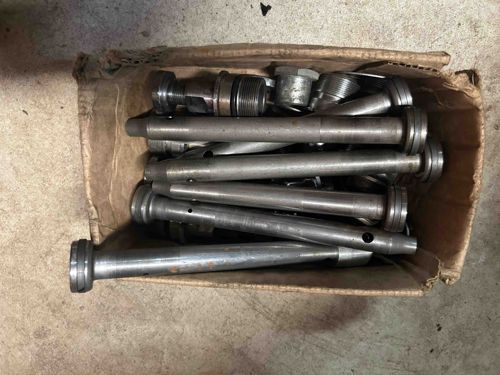
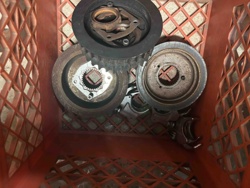
This image displays a collection of what appear to be piston pins, or gudgeon pins, for an internal combustion engine, contained within a distressed cardboard box. The pins are predominantly cylindrical, varying slightly in length and diameter, suggesting they may be from different engine applications or different positions within an assembly. Each pin is made of a metallic material, likely hardened steel, exhibiting a matte grey, industrial finish with noticeable wear and a slight patina consistent with age and storage, rather than active use. Some pins feature a smooth, polished main shaft, while others show subtle machining marks. Visible features include a flanged or collared end on some, possibly for retaining clips or a specific fitment, and small circular holes or bored-out sections on others. These holes are characteristic of hollow piston pins, designed to reduce weight, or cross-drilled holes for lubrication passages. The pins are generally uniform in their construction, indicating mass production for mechanical applications. There are no clear maker's marks or identifying stamps visible in the image, making specific manufacturing details or a precise age difficult to ascertain. However, their robust construction and visible signs of minor corrosion or surface rust on some pieces suggest they could be older stock, possibly from the mid-20th century to late 20th century, or simply parts kept in a less-than-ideal storage environment. The quality of craftsmanship appears to be industrial standard, suitable for their intended mechanical purpose, with no obvious signs of significant damage that would render them unusable, though a detailed inspection would be required to confirm their integrity.
AI Appraisal Report
Upon visual examination of the provided image, I observe an assortment of piston pins, or gudgeon pins, housed within a distressed cardboard container. The pins appear to be of various sizes, suggesting their use across different engine models or applications. Condition-wise, they exhibit a matte grey, industrial finish with noticeable wear and a slight patina, consistent with age and storage rather than heavy prior use. Some pieces show minor corrosion or surface rust, indicative of storage in a less-than-ideal environment. Their construction details, such as flanged ends and bored-out sections, align with standard piston pin designs for weight reduction and lubrication. Authenticity, based solely on this image, seems to confirm them as genuine automotive engine components. However, without clear maker's marks or part numbers visible, precise manufacturing details and age are difficult to ascertain. They likely originate from the mid-to-late 20th century given their appearance and storage method.
Market conditions for such generic, unidentifiable used automotive components are typically low. While piston pins themselves are essential, this assortment lacks specific identification for popular or rare applications that would drive significant demand. Their 'used' or 'new old stock' status, ambiguous origins, and the lack of specific engine fitment limit their market appeal. Comparables would include bulk lots of unspecified engine hardware, which tend to fetch minimal prices, often sold by weight or as scrap.
The rarity is low; piston pins are mass-produced items. Demand for these specific, uncatalogued pins is negligible, as most mechanics and restorers require new, precisely sized, and type-specific parts. The primary value impactors are the lack of identification, varied sizes, and general condition, preventing them from being sold as new or specialized parts.
Limitations in authenticity verification are significant. From an image, I cannot confirm the exact material composition, hardness, precise dimensions, internal integrity (e.g., micro-fractures), or whether they are truly new old stock versus lightly used. Full authentication and accurate valuation would require in-person examination to measure dimensions, identify potential part numbers (even faint ones), assess metallurgical properties, and ideally, review any provenance documentation for their origin (e.g., from a specific engine teardown, dealership old stock). Without this, they remain a collection of generic used engine components, severely impacting their potential value.