Lower Paleo Chert Biface Hand Axe/Hammerstone
Anthropological & Archaeological Artifacts

Lower Paleo Chert Biface Hand Axe/Hammerstone

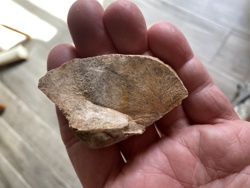
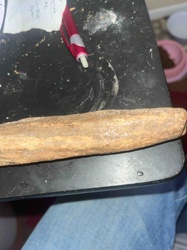
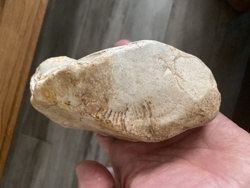
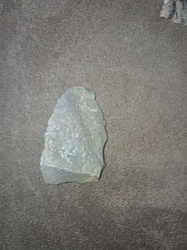
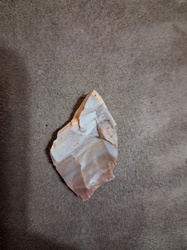
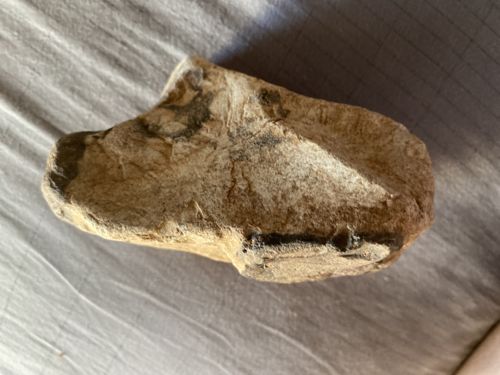
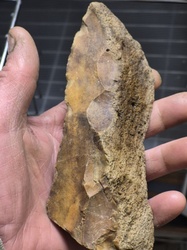
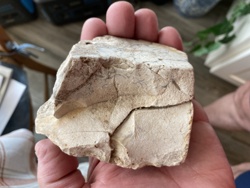
An authentic Lower Paleo era artifact measuring approximately 4 by 2.25 inches, discovered in Guthrie, Oklahoma. This specimen is crafted from chert and exhibits characteristic bifacial chipping, a hallmark of early lithic technology. The item displays a mix of earthy tones ranging from tan to light brown, with visible dark inclusions and iron-rich staining consistent with long-term burial in regional soil. The physical construction features a robust, hefty profile suitable for multi-purpose use. One end tapers toward a crude cutting edge produced by flake removal, while the butt end shows significant blunting and crushing wear, suggesting its use as a hammerstone or percussion tool. Surface patina is heavy and consistent across the facets, which serves to differentiate ancient percussion marks from modern damage. The artifact displays significant edge fatigue and ancient micro-fractures, typical for a tool utilized in heavy-duty tasks such as butchery or mineral processing. While it lacks modern maker's marks, the craftsmanship reflects the Acheulean or similar early stone-tool tradition, focusing on utility over aesthetic symmetry. The presence of some remaining cortex (original outer stone skin) highlights the opportunistic nature of its manufacture from a local chert nodule. Its condition is remarkably intact for its age, preserved with no recent breaks or modern repairs.
Estimated Value

$150 - $250

Basic Information

Category

Anthropological & Archaeological Artifacts

Appraised On

February 20, 2026

Estimated Value

$150 - $250

Additional Details Provided By Owner

User Provided Information

Lower Paleo chert bi face hand axe hammer stone tool found in Guthrie OK 4"x 2.25

Item Description

An authentic Lower Paleo era artifact measuring approximately 4 by 2.25 inches, discovered in Guthrie, Oklahoma. This specimen is crafted from chert and exhibits characteristic bifacial chipping, a hallmark of early lithic technology. The item displays a mix of earthy tones ranging from tan to light brown, with visible dark inclusions and iron-rich staining consistent with long-term burial in regional soil. The physical construction features a robust, hefty profile suitable for multi-purpose use. One end tapers toward a crude cutting edge produced by flake removal, while the butt end shows significant blunting and crushing wear, suggesting its use as a hammerstone or percussion tool. Surface patina is heavy and consistent across the facets, which serves to differentiate ancient percussion marks from modern damage. The artifact displays significant edge fatigue and ancient micro-fractures, typical for a tool utilized in heavy-duty tasks such as butchery or mineral processing. While it lacks modern maker's marks, the craftsmanship reflects the Acheulean or similar early stone-tool tradition, focusing on utility over aesthetic symmetry. The presence of some remaining cortex (original outer stone skin) highlights the opportunistic nature of its manufacture from a local chert nodule. Its condition is remarkably intact for its age, preserved with no recent breaks or modern repairs.
Get Your Items Appraised

Instant estimates of your treasures with AI-powered instant appraisals

Browse More Appraisals