These notes were written by the person who submitted this item. Appraiser.AI has not verified them, and the AI's identification and estimate may rely on them.
AI Estimated Value
Not an official valuation
$100-200
AI estimate as of August 2, 2025 · verify with a professional before acting
AI-Generated · Verify before acting
Everything on this page is generated by AI for informational purposes only. AI can make mistakes — the AI may misidentify items or misattribute them (artist, maker, brand, designer, origin, era). This is not an official valuation and should not be used for insurance, sale, tax, estate, legal, or lending purposes — or any decision requiring a certified appraisal. It is not an authoritative claim about any person, brand, or rights holder — do not share or rely on it as a factual statement about a third party. Always consult qualified professionals before making financial decisions.
This analysis also relies on unverified notes provided by the user, which may be incomplete or inaccurate and could affect the result.
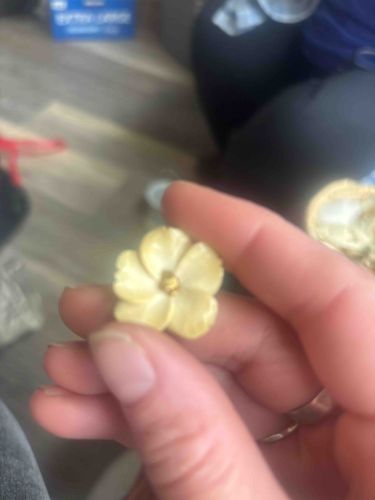
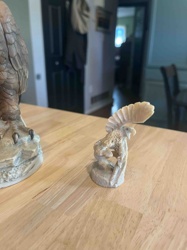
The item is a small, hand-carved piece in the shape of a five-petaled flower, possibly intended as a button, bead, or small decorative element. Given the additional context of 'Ivory Alaskan art', it is highly probable that the material is ivory, likely walrus ivory due to its historical use in Alaskan Native carvings, rather than elephant ivory which is globally restricted due to conservation efforts. The color of the material is a light, creamy yellow-beige, consistent with aged or stained ivory, exhibiting a subtle translucency in thinner areas. The carving demonstrates delicate craftsmanship, with each petal distinctively shaped and slightly curved to give the flower a three-dimensional, naturalistic appearance. The center of the flower features a small, raised circular element, which appears to be a small brass or gold-toned metal pin or grommet. This central detail is likely functional, perhaps for attachment to another item, or purely decorative to simulate the stamen of a flower. There are no obvious chips, cracks, or significant damage visible on the carved surface, suggesting good preservation. The surface appears smooth and polished, consistent with careful finishing, though some minor surface wear or natural patination from handling might be present. The estimated age, considering it as 'Alaskan art' and carved from ivory, could range from the early to mid-20th century or possibly older, depending on the origin and specific carving traditions. The overall quality of the carving indicates skilled artistry, with attention to detail in shaping the organic form. No overt maker's marks or signatures are discernible from the provided image.
AI Appraisal Report
Upon examining the provided image and the owner's assertion of 'Ivory Alaskan art', I assess this carved floral piece. The material's color and translucency are consistent with aged walrus ivory, commonly used in Alaskan Native carvings. The craftsmanship demonstrates delicate, three-dimensional carving, indicating skilled artistry. The metal center appears to be a brass or gold-toned pin, likely for attachment or decorative stamen. The overall condition appears good, with no obvious chips or cracks, and a smooth, polished finish suggesting careful preservation and use.
Market conditions for Alaskan ivory art, particularly older pieces, remain stable. While demand exists for authentic Native carvings, the smaller size and indeterminate function (button, bead, or decorative element) of this piece may limit its appeal compared to larger, more sculptural forms. Comparables would include other small Alaskan ivory carvings or beads, though a direct match for this specific floral design with a metal center is less common, possibly contributing to a degree of rarity. The 'ivory' designation potentially adds value, but the small scale and lack of a definitive artist or tribal affiliation mean it won't command prices associated with master carvers or larger, narrative pieces.
The primary limitation to a definitive appraisal and authenticity verification from an image alone is the inability to perform an in-person examination. Physical inspection would allow me to confirm the ivory type (e.g., walrus vs. elephant, if any doubt, though unlikely given context), check for tool marks, assess patination, and examine the metal inclusion more closely. Provenance documentation, such as collection history or tribal origin, would significantly enhance value and authenticity. Scientific testing, like CITES documentation or microscopic analysis, would be necessary for absolute authentication of ivory origin, if concerns arose.