AI Appraisal Estimate

AI-generated estimates · not official valuations

From the user

What was submitted

Photo and notes provided by the user — not generated by AI

Submitted item photo
Submitted photo · June 26, 2026

User's notes

No additional notes provided.

AI analysis below

AI appraisal

AI analysis & estimate

AI-Generated · Verify before acting

Everything below is generated by AI for informational purposes only. AI can make mistakes — the AI may misidentify items or misattribute them (artist, maker, brand, designer, origin, era). This is not an official valuation and should not be used for insurance, sale, tax, estate, legal, or lending purposes — or any decision requiring a certified appraisal. It is not an authoritative claim about any person, brand, or rights holder — do not share or rely on it as a factual statement about a third party. Always consult qualified professionals before making financial decisions.

Read the full disclaimer

AI Identification

·Not independently authenticated·Verify before acting

Prehistoric Lithic Tool (Stone Adze or Hand Axe Preform)

Archaeological Artifacts and Antiquities

AI Estimated Value

·Not an official valuation·Verify before acting

$250 - $450

As of June 26, 2026

AI Item Analysis

·AI can make mistakes·Verify before acting
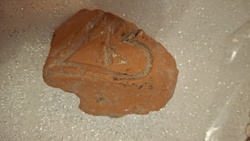
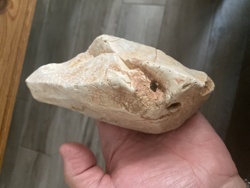
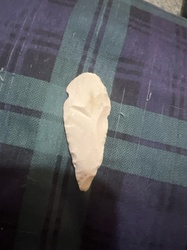
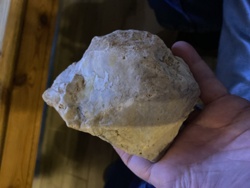
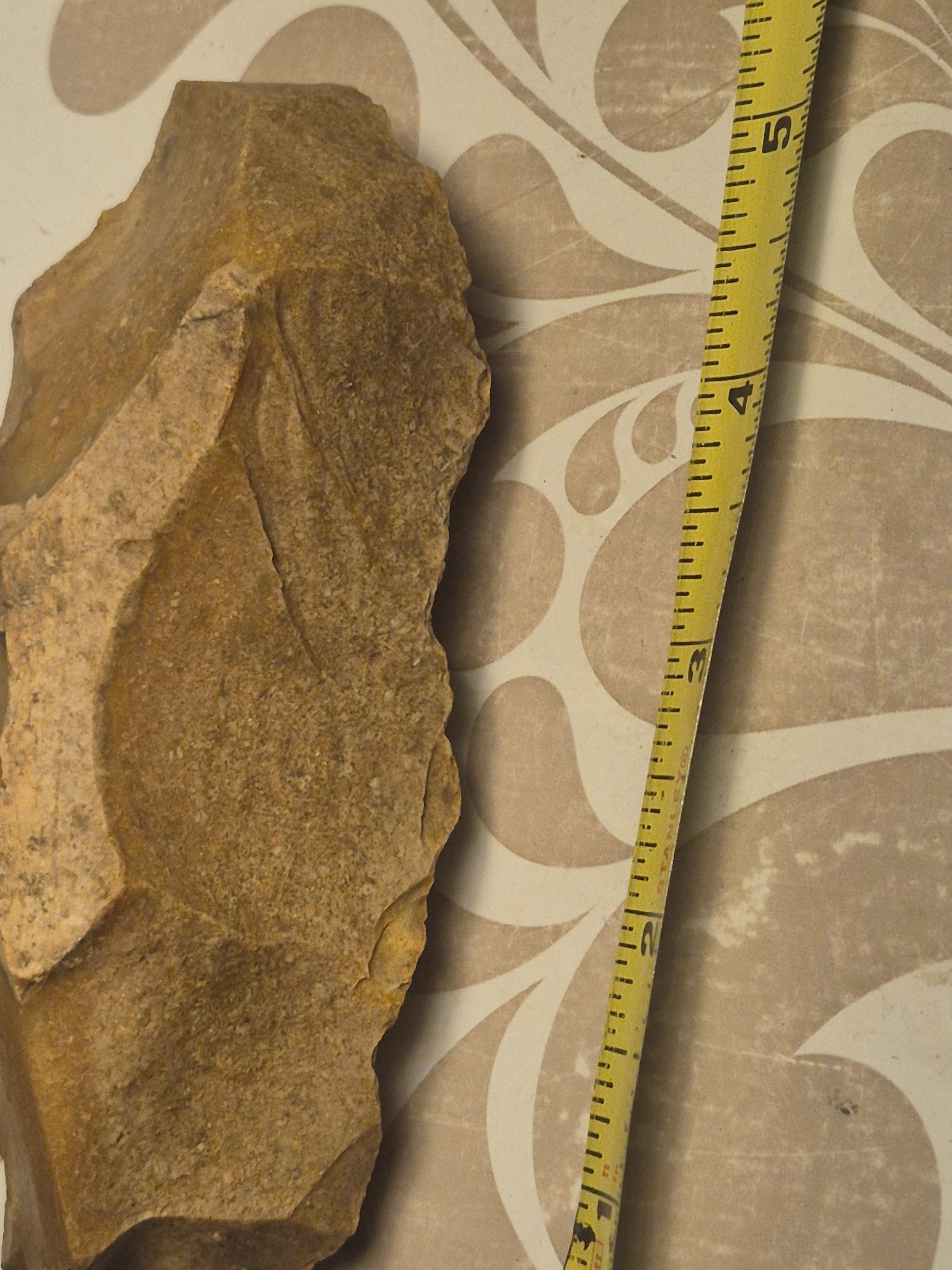
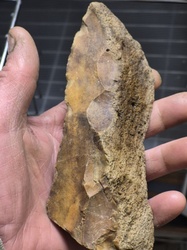
This item is a prehistoric stone tool, likely a hand axe or an adze preform, crafted from a fine-grained lithic material such as chert or quartzite. The object measures approximately 5 inches in length, as indicated by the adjacent yellow measuring tape. It exhibits characteristic percussion flaking, with large, shallow flake scars visible across the dorsal surface, suggesting it was shaped using hard-hammer percussion techniques. The material has an earthy, tan-to-ochre color with a speckled, granular mineral composition. The edges appear roughly serrated from the knapping process, though they show significant weathering and rounding, which may be indicative of river-rolling or ancient use-wear. There is a distinct bulb of percussion near the base and a tapered, bifacially worked distal end. The condition is consistent with an archaeological find, displaying heavy surface patina, minor impact fractures, and embedded sediment. No modern markings or signatures are present. This piece likely dates to the Late Paleolithic or Archaic period and represents a multi-functional tool used for chopping or scraping tasks. Its robust construction and purposeful shaping reflect high-quality prehistoric craftsmanship.
AI Appraisal Report

·AI can make mistakes·Verify before acting
I have examined the digital images of this prehistoric stone tool, measuring approximately 5 inches. Based on the morphology and the presence of hard-hammer percussion flaking, this piece appears to be a functional bifacial tool, likely an adze preform or hand axe, consistent with Archaic period lithic technologies. The tan-to-ochre patination and the rounding of the flake scars are indicative of legitimate antiquity, suggesting the item has been subjected to significant environmental exposure or river-rolling. The absence of modern steel tool marks or fresh hinge fractures supports a prehistoric origin. The current market for North American and European lithic artifacts remains steady, though values are heavily dependent on provenance. Comparative sales of unprovenanced bifaces of this size generally fall in the low-to-mid hundreds. The value is capped by the lack of specific find-spot data, as archaeological context is vital for premium pricing. While the physical characteristics—such as the bulb of percussion and granular mineral composition—align with authentic artifacts, I must note the inherent limitations of a remote appraisal. To confirm authenticity and maximize market value, an in-person examination by a lithic specialist is required to rule out modern 'knap-ins.' Furthermore, verifiable documentation of the chain of custody (provenance) and a microscopic analysis of use-wear patterns would be necessary to distinguish between a genuine ancient tool and a modern reproduction or a geofact. Given the robust construction and visible patina, it is a significant piece for a private collector of lithic technology.

Get your items appraised

Instant estimates of your treasures with AI-powered appraisals

Browse More Appraisals