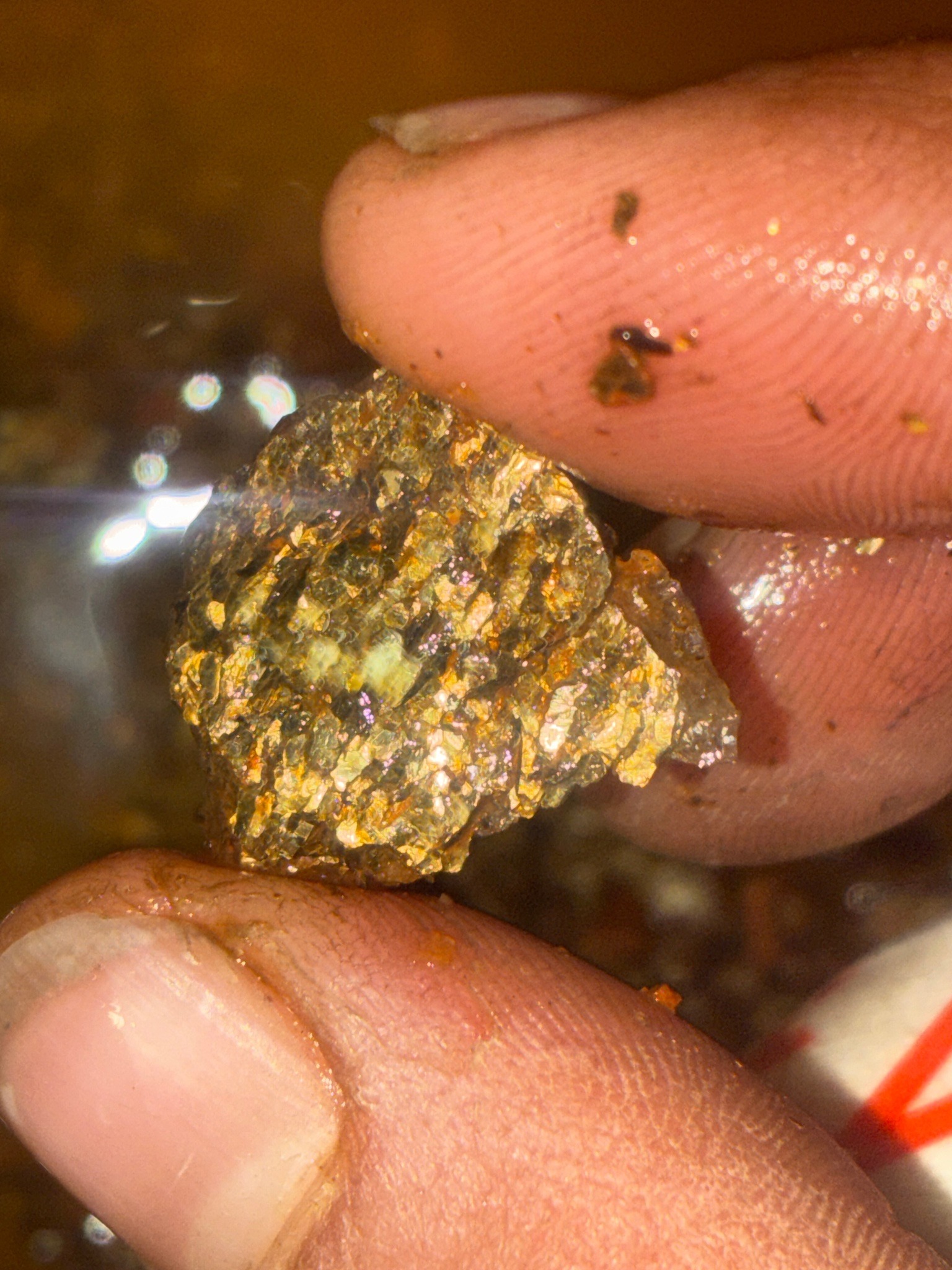
Chalcopyrite Specimen with Peacock Iridescence
Mineral Specimens / Geology

Chalcopyrite Specimen with Peacock Iridescence

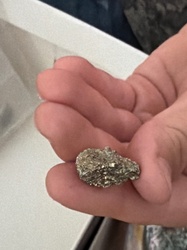
This item is a small, raw mineral specimen, approximately 1.5 to 2 centimeters in length, held between two fingers for scale. The specimen exhibits a complex, crystalline structure with a metallic luster characteristic of sulfide minerals. Its primary coloration is a deep brassy-yellow or golden hue, but it is most notable for its vibrant iridescent tarnish, featuring flecks of purple, blue, and orange, often referred to as 'peacock ore.' The texture is rough and uneven, showing irregular fracture patterns and a somewhat flaky or foliated appearance in certain sections where the mineral layers meet. The surfaces are highly reflective under direct light, emphasizing its metallic nature. There is evidence of some host rock or quartz-like matrix on the far right edge, which is more translucent and colorless compared to the metallic ore. The specimen shows no signs of synthetic polishing or tumbling, retaining its natural, jagged edges and uneven surface topography. Its condition appears stable, though common for this mineral, it may be brittle. This type of mineral is typically formed in hydrothermal veins and is a primary ore of copper.
Estimated Value

$10.00-$25.00

Basic Information

Category

Mineral Specimens / Geology

Appraised On

May 5, 2026

Estimated Value

$10.00-$25.00

Item Description

This item is a small, raw mineral specimen, approximately 1.5 to 2 centimeters in length, held between two fingers for scale. The specimen exhibits a complex, crystalline structure with a metallic luster characteristic of sulfide minerals. Its primary coloration is a deep brassy-yellow or golden hue, but it is most notable for its vibrant iridescent tarnish, featuring flecks of purple, blue, and orange, often referred to as 'peacock ore.' The texture is rough and uneven, showing irregular fracture patterns and a somewhat flaky or foliated appearance in certain sections where the mineral layers meet. The surfaces are highly reflective under direct light, emphasizing its metallic nature. There is evidence of some host rock or quartz-like matrix on the far right edge, which is more translucent and colorless compared to the metallic ore. The specimen shows no signs of synthetic polishing or tumbling, retaining its natural, jagged edges and uneven surface topography. Its condition appears stable, though common for this mineral, it may be brittle. This type of mineral is typically formed in hydrothermal veins and is a primary ore of copper.
Get Your Items Appraised

Instant estimates of your treasures with AI-powered instant appraisals

Browse More Appraisals