These notes were written by the person who submitted this item. Appraiser.AI has not verified them, and the AI's identification and estimate may rely on them.
AI Estimated Value
Not an official valuation
$40-70
AI estimate as of July 26, 2025 · verify with a professional before acting
AI-Generated · Verify before acting
Everything on this page is generated by AI for informational purposes only. AI can make mistakes — the AI may misidentify items or misattribute them (artist, maker, brand, designer, origin, era). This is not an official valuation and should not be used for insurance, sale, tax, estate, legal, or lending purposes — or any decision requiring a certified appraisal. It is not an authoritative claim about any person, brand, or rights holder — do not share or rely on it as a factual statement about a third party. Always consult qualified professionals before making financial decisions.
This analysis also relies on unverified notes provided by the user, which may be incomplete or inaccurate and could affect the result.
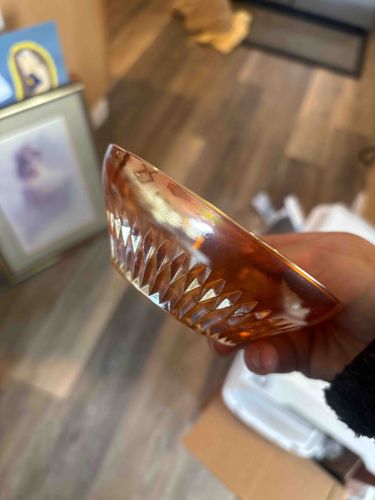
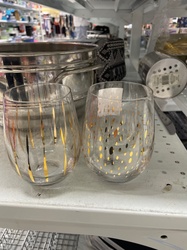
The item is a small, round glass bowl, distinguished by its iridescent orange-amber color, characteristic of carnival glass. Its surface exhibits a prominent diamond pattern, likely achieved through pressing or molding, which creates a textured exterior that catches and reflects light. The iridescence displays a spectrum of warm tones, including coppery oranges, golden yellows, and hints of pink or red, shifting with the angle of light due to a metallic salt spray applied during manufacturing. The rim of the bowl appears smooth and slightly flared, indicating a finishing process, possibly fire-polished. The interior surface seems largely smooth, highlighting the depth of the color. Given the context of 'Crystal' provided, it suggests a material with some refractive qualities, although the primary visual characteristic points to iridescent glass. There are no clearly discernible maker's marks or signatures visible in the provided image. The style and coloration strongly suggest it is a piece of carnival glass, popular from the early 20th century, roughly 1900-1930s. The craftsmanship, while mass-produced, shows a consistent pattern and an appealing luster. There are no obvious signs of chips, cracks, or significant wear visible from the provided angles; the surface appears intact, though typical minor manufacturing imperfections such as straw marks or tiny bubbles might be present upon closer inspection.
AI Appraisal Report
Upon examining the provided image and information, I assess this iridescent orange-amber glass bowl with a prominent diamond pattern as a classic example of Carnival Glass. My visual inspection suggests its condition is excellent, showing no obvious chips, cracks, or significant wear. The iridescence, ranging from coppery oranges to golden yellows, is vibrant and consistent with the metallic salt application characteristic of Carnival Glass. The smooth, slightly flared rim indicates typical finishing. While the owner mentioned 'Crystal,' the visual evidence strongly points to iridescent pressed glass, not true crystal, which aligns with common Carnival Glass manufacturing. Authenticity as Carnival Glass is highly likely based on its distinctive color, pattern, and iridescence. However, I must note that definitive authentication of material composition (glass vs. crystal) and the presence of typical minor manufacturing imperfections (straw marks, bubbles) would require direct physical examination. Market conditions for common Carnival Glass patterns like this one are stable but not rapidly appreciating. Comparables for similar-sized, diamond-patterned Carnival Glass bowls in excellent condition typically range from \"good\" to \"very good\" condition. Demand is steady among collectors of early 20th-century American pressed glass. Rarity is low; this pattern, while appealing, is not uncommon. Factors impacting value include its excellent apparent condition and appealing iridescence. Without a maker's mark, it's challenging to attribute it to a specific manufacturer, which limits its top-tier value. Full authentication would ideally involve in-person examination for detailed assessment of manufacturing techniques, material composition, and any subtle condition issues, as well as checking for hidden marks and comparing with documented patterns. Provenance documentation, if available, would further enhance its historical and market value.