These notes were written by the person who submitted this item. Appraiser.AI has not verified them, and the AI's identification and estimate may rely on them.
AI Estimated Value
Not an official valuation
$800 - $1,500
AI estimate as of December 9, 2025 · verify with a professional before acting
AI-Generated · Verify before acting
Everything on this page is generated by AI for informational purposes only. AI can make mistakes — the AI may misidentify items or misattribute them (artist, maker, brand, designer, origin, era). This is not an official valuation and should not be used for insurance, sale, tax, estate, legal, or lending purposes — or any decision requiring a certified appraisal. It is not an authoritative claim about any person, brand, or rights holder — do not share or rely on it as a factual statement about a third party. Always consult qualified professionals before making financial decisions.
This analysis also relies on unverified notes provided by the user, which may be incomplete or inaccurate and could affect the result.
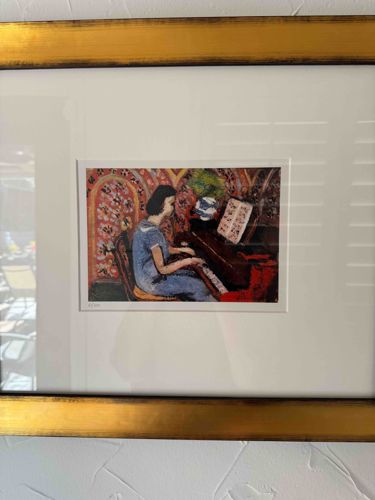
This item is a framed lithograph print attributed to Henri Matisse, depicting a young woman playing a piano. The artwork is presented within a robust, ornate gold-colored frame, which appears to be made of wood or a composite material, featuring a slightly textured or brushed finish that suggests an antique or distressed aesthetic. The print itself shows a seated female figure, presumably a young woman, with dark hair, wearing a light blue dress or tunic with a rounded collar. She is positioned before a dark-colored upright piano, her hands resting on the keys. On top of the piano, to the left, there's a vase with green foliage, and to the right, sheet music is displayed. The background features a vibrant and intricately patterned wallpaper or tapestry in shades of red, pink, and white, creating an arch-like motif around the figure. The artistic style is characteristic of Matisse's later works, possibly suggesting a Fauvist or Post-Impressionist influence with bold colors and simplified forms. Below the main image, in the lower left corner, there is a visible numerical inscription '9/300', indicating that this is a limited edition print, specifically the 9th impression out of a total edition of 300. This numbering signifies its nature as a lithograph rather than an original painting. The print is housed under glass or acrylic glazing and matted with a clean, white, acid-free matboard, which provides a border between the artwork and the frame. The overall condition appears excellent, with no immediately visible tears, creases, fading, or damage to the print itself. The frame also seems well-maintained, without significant chips or scratches, though minor signs of age or handling could be present but are not discernible from the image. The quality of the print and framing suggests a professionally produced and displayed piece of art. Given the context, the estimated age would likely be 20th century, possibly mid to late 20th century if it's a posthumous edition, or earlier if it's a vintage impression.
AI Appraisal Report
Based on my visual examination of the provided image, this framed lithograph, attributed to Henri Matisse and titled 'Young Woman Playing the Piano,' appears to be in excellent condition. The print is vibrant, showing no visible signs of fading, tears, or creases. The framing is professional, featuring a clean white mat and an ornate gold-colored frame, both of which seem well-maintained. The numerical inscription '9/300' clearly indicates a limited edition lithograph, not an original painting, which is crucial for valuation. The subject matter and stylistic elements are consistent with Matisse's work, particularly his later period, suggesting a strong influence of Fauvism or Post-Impressionism.
Market demand for Matisse's signed or posthumous lithographs remains consistently strong. Limited editions, especially those with lower numbering in the edition like '9/300,' often command higher prices, although the overall edition size of 300 is relatively common for prints of this nature. Comparable sales for authenticated Matisse lithographs of similar size and subject matter, particularly those from posthumous editions, typically range from several hundred to a few thousand dollars, depending on provenance, exact print quality, and whether it is signed in plate or by hand.
However, it is critical to state that my assessment of authenticity is limited by examining images alone. While the print's characteristics align with known Matisse lithographs, definitive authentication requires an in-person examination by a Matisse print expert or a recognized art authenticator. This would involve inspecting the paper, printing process, specific publisher marks, and comparing it against known examples. Furthermore, full provenance documentation, detailing the print's ownership history, is essential for confirming its legitimacy and maximizing its market value. Without these, the value remains an estimate for an 'attributed' piece.