Vintage Western Tooled Leather Saddle
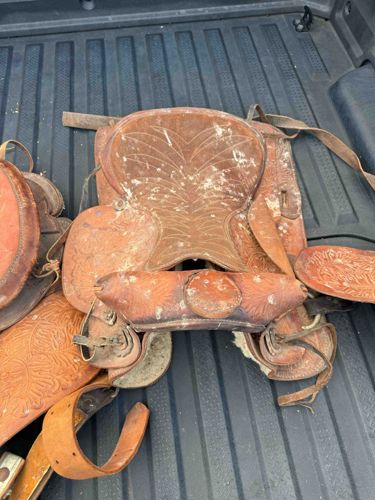
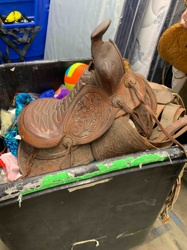
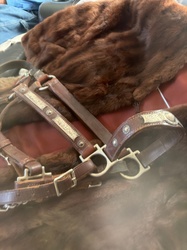
This is a vintage Western-style horse saddle featuring heavy leather construction with intricate hand-tooled floral and leaf patterns. The saddle is primarily a reddish-brown russet color. Notable physical characteristics include a high cantle with a distinct decorative stitching pattern on the seat, a rounded fork with a leather-covered horn, and broad skirts and fenders embellished with floral tooling. The leather appears thick and of high quality, typical of mid-20th-century craftsmanship. However, the condition is poor to fair; there is significant white spotting across the seat and fenders, which could be mold, mildew, or paint splatter. The leather shows signs of dehydration, surface cracking, and general wear from use. Metal hardware, including the rigging rings, shows oxidation and dirt buildup. The sheepskin lining on the underside appears matted and soiled. No visible maker's mark is immediately apparent in the top-down view, but the style is consistent with American Western tack from the 1940s to 1960s. The intricate tooling indicates a once-high-end piece of equestrian equipment that now requires extensive professional cleaning and leather conditioning to restore its structural integrity and aesthetic value.
AI-Generated Appraisal Disclaimer
Estimated Value
$250 - $450
Basic Information
Category
Equestrian Equipment / Western Tack
Appraised On
January 12, 2026
Estimated Value
$250 - $450
Item Description
This is a vintage Western-style horse saddle featuring heavy leather construction with intricate hand-tooled floral and leaf patterns. The saddle is primarily a reddish-brown russet color. Notable physical characteristics include a high cantle with a distinct decorative stitching pattern on the seat, a rounded fork with a leather-covered horn, and broad skirts and fenders embellished with floral tooling. The leather appears thick and of high quality, typical of mid-20th-century craftsmanship. However, the condition is poor to fair; there is significant white spotting across the seat and fenders, which could be mold, mildew, or paint splatter. The leather shows signs of dehydration, surface cracking, and general wear from use. Metal hardware, including the rigging rings, shows oxidation and dirt buildup. The sheepskin lining on the underside appears matted and soiled. No visible maker's mark is immediately apparent in the top-down view, but the style is consistent with American Western tack from the 1940s to 1960s. The intricate tooling indicates a once-high-end piece of equestrian equipment that now requires extensive professional cleaning and leather conditioning to restore its structural integrity and aesthetic value.
Get Your Items Appraised
Instant estimates of your treasures with AI-powered instant appraisals