AI Appraisal Estimate

AI-generated estimates · not official valuations

From the user

What was submitted

Photo and notes provided by the user — not generated by AI

Submitted item photo
Submitted photo · June 12, 2026

User's notes

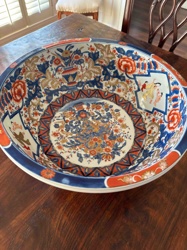
Imari platter

AI analysis below

AI appraisal

AI analysis & estimate

AI-Generated · Verify before acting

Everything below is generated by AI for informational purposes only. AI can make mistakes — the AI may misidentify items or misattribute them (artist, maker, brand, designer, origin, era). This is not an official valuation and should not be used for insurance, sale, tax, estate, legal, or lending purposes — or any decision requiring a certified appraisal. It is not an authoritative claim about any person, brand, or rights holder — do not share or rely on it as a factual statement about a third party. Always consult qualified professionals before making financial decisions.

Note

This analysis also relies on unverified notes provided by the user, which may be incomplete or inaccurate and could affect the result.

Read the full disclaimer

AI Identification

·Not independently authenticated·Verify before acting

Japanese Arita Blue and White Imari Hand-Painted Porcelain Charger

Antique Asian Ceramics

AI Estimated Value

·Not an official valuation·Verify before acting

$450.00 - $700.00

As of June 12, 2026

AI Item Analysis

·AI can make mistakes·Verify before acting
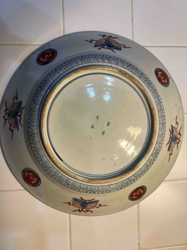
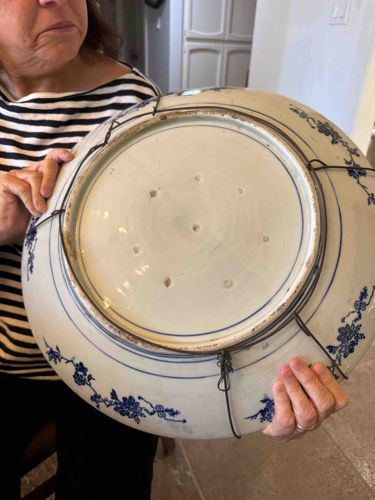
This is the reverse side of a large Japanese Arita porcelain charger, likely dating to the late 19th century (Meiji Period). The piece is constructed from a heavy, dense white porcelain paste and features underglaze cobalt blue floral sprays around the outer rim. A defining characteristic of this piece is the presence of several circular 'spur marks' inside the foot rim, which are remnants of kiln supports used during the firing process to prevent sagging. The platter is circular with a broad, deep well and a prominent unglazed foot rim showing a medium-to-coarse grit and some natural oxidation. The glaze has a slight blue-green tint characteristic of historic Arita production. The exterior decoration shows fluid, hand-painted floral motifs and scrolls. Condition-wise, the piece appears structurally sound, though there is visible surface wear, minor pitting (pinholes) in the glaze, and significant surface dirt and oxidation on the unglazed foot. It is currently held by a vintage wire plate hanger, which shows some rusting; such hangers can be a risk for chipping the edges. No visible maker's marks are present on the base, which is common for large chargers of this period where the artistry on the front was the primary focus.
AI Appraisal Report

·AI can make mistakes·Verify before acting
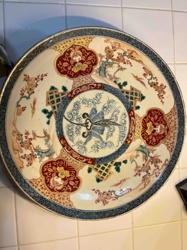
Based on my examination of this Japanese Arita porcelain charger, I have identified it as a late Meiji Period (c. 1880–1912) export piece. The heavy porcelain body, characteristic blue-green glaze tint, and the presence of prominent spur marks within the foot rim are consistent with traditional Arita/Imari kiln practices. The hand-painted cobalt blue floral scrolling on the reverse demonstrates a standard of workmanship expected for large-scale utilitarian or decorative export wares of the late 19th century. The condition appears fair for its age; however, the presence of oxidation, kiln grit on the foot, and glaze pitting suggests a mid-tier production quality rather than imperial or museum-grade craftsmanship. The use of a wire hanger is a concern, as these often cause edge chipping over time. The market for Meiji-era blue and white porcelain remains stable, though prices for unsigned chargers have softened compared to polychrome 'brocade' patterns. Comparables sold at auction typically range between $400 and $800 depending on the complexity of the front-side decoration, which was not visible here. Please note that this valuation is based solely on photographic evidence. A definitive authentication would require a hands-on physical inspection to verify the tactile nature of the glaze, a 'ring test' for structural integrity (to check for hidden hairline cracks), and ultraviolet light examination to detect professional restorations. Provenance documentation or a detailed view of the obverse decoration would be necessary to further refine the rarity and market appeal of this specific example.

Get your items appraised

Instant estimates of your treasures with AI-powered appraisals

Browse More Appraisals