AI Appraisal Estimate

AI-generated estimates · not official valuations

From the user

What was submitted

Photo and notes provided by the user — not generated by AI

Submitted item photo
Submitted photo · June 15, 2026

User's notes

No additional notes provided.

AI analysis below

AI appraisal

AI analysis & estimate

AI-Generated · Verify before acting

Everything below is generated by AI for informational purposes only. AI can make mistakes — the AI may misidentify items or misattribute them (artist, maker, brand, designer, origin, era). This is not an official valuation and should not be used for insurance, sale, tax, estate, legal, or lending purposes — or any decision requiring a certified appraisal. It is not an authoritative claim about any person, brand, or rights holder — do not share or rely on it as a factual statement about a third party. Always consult qualified professionals before making financial decisions.

Read the full disclaimer

AI Identification

·Not independently authenticated·Verify before acting

Victorian Era Glazed Ceramic Cheese Dish

Antique Ceramics & Tableware

AI Estimated Value

·Not an official valuation·Verify before acting

$40-75

As of June 15, 2026

AI Item Analysis

·AI can make mistakes·Verify before acting
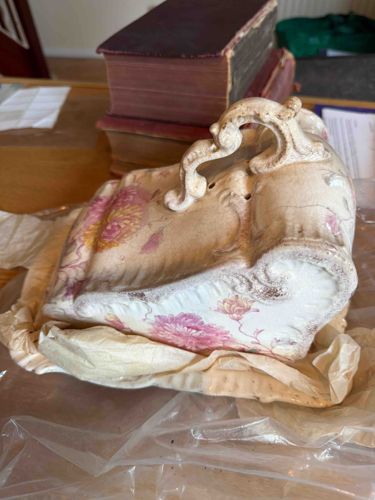
This is a Victorian-era glazed ceramic cheese dish, likely of English origin (e.g., Staffordshire or Minton style). The piece features a distinct wedge-shaped cover sits atop a matching undertray. It is constructed from heavy earthenware or ironstone with a cream-toned base glaze. The decorative program consists of pink and yellow transfer-ware floral motifs, specifically peonies or roses, which were highly popular during the late 19th century. The handle is ornately molded in a Rococo-revival or 'scroll' style, showing high-relief craftsmanship. The edges of the cover and tray are further embellished with embossed scrollwork and gadrooning. Regarding its condition, the item shows significant signs of age and wear. There is prominent 'crazing' (fine cracking) across the glaze surface, and notable discoloration or staining, particularly along the lower rim, which is common in antique porous ceramics. A large, visible vertical crack is present on the right side of the cover, extending from the base upward. There is also evident gold-leaf loss on the handle and raised edges where the original gilding has worn away to reveal the white body beneath. The piece displays a thick, glossy glaze typical of the 1880-1900 period. No maker's mark is visible in the current view, but it exemplifies the mass-produced yet highly decorative domestic tablewares of the Industrial Art movement in the United Kingdom.

AI Appraisal Report

·AI can make mistakes·Verify before acting
Based on my visual examination of this Victorian-era ceramic cheese dish, the item is characteristic of high-volume English earthenware manufactured between 1880 and 1900. While the transfer-ware floral patterns and Rococo-revival molding are aesthetically pleasing and authentic to the period, the piece suffers from significant condition issues that severely impact its market value. The visible vertical crack on the cover is a structural defect that prevents the item from being used for its original purpose and is a major deterrent for serious collectors. Additionally, the heavy crazing and localized staining indicate that moisture and fats have penetrated the porous body, a common but detracting feature in 19th-century utility wares. The market for 'brown furniture' and associated Victorian tablewares has softened considerably over the last decade. Comparables in pristine condition with intact gilding typically fetch between $150 and $250. However, due to the lack of a visible maker's mark (such as George Jones or Wedgwood) and the documented damage, this piece is valued primarily as a decorative 'shelf piece' rather than a museum-quality specimen. Note: This appraisal is based solely on digital imagery. A full authentication would require an in-person physical inspection to assess the weight and 'ring' of the ceramic (testing for hidden repairs), as well as a search for impressed date codes or registration diamonds on the underside of the tray. Verification of provenance or original purchase receipts would also be necessary to provide a definitive valuation for insurance or legal purposes.

Get your items appraised

Instant estimates of your treasures with AI-powered appraisals

Browse More Appraisals