These notes were written by the person who submitted this item. Appraiser.AI has not verified them, and the AI's identification and estimate may rely on them.
AI Estimated Value
Not an official valuation
$40-75
AI estimate as of September 8, 2025 · verify with a professional before acting
AI-Generated · Verify before acting
Everything on this page is generated by AI for informational purposes only. AI can make mistakes — the AI may misidentify items or misattribute them (artist, maker, brand, designer, origin, era). This is not an official valuation and should not be used for insurance, sale, tax, estate, legal, or lending purposes — or any decision requiring a certified appraisal. It is not an authoritative claim about any person, brand, or rights holder — do not share or rely on it as a factual statement about a third party. Always consult qualified professionals before making financial decisions.
This analysis also relies on unverified notes provided by the user, which may be incomplete or inaccurate and could affect the result.
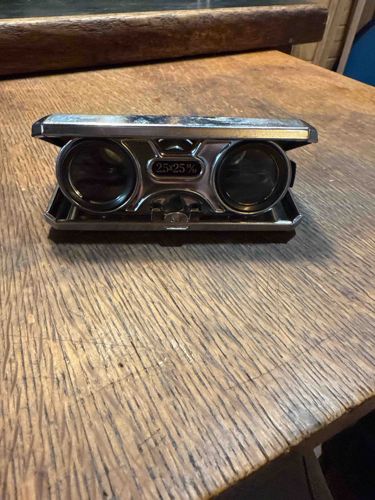
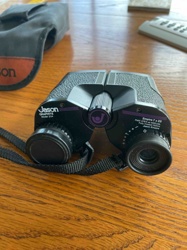
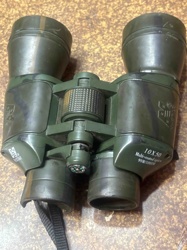
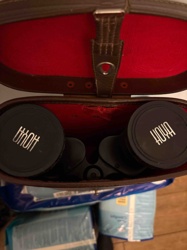
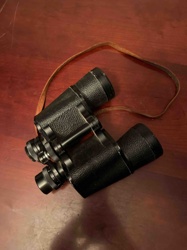
This item is a pair of vintage, compact opera glasses or field binoculars, likely from the early to mid-20th century. They feature a monocular style construction, where the two objective lenses are presented side-by-side without a central hinge, and are housed within a rectangular, possibly collapsible or sliding, casing. The primary material appears to be a polished metal, likely brass or nickel-plated brass, given the reflective, silver-toned surface and visible patina. There are distinct signs of wear, including tarnishing and minor abrasions on the metal surfaces, consistent with age and use. The casing exhibits a textured or engraved finish on the top surface, contrasting with the smooth, polished sides. The lenses are dark and appear to be in reasonable condition, with no obvious cracks or severe scratches visible from this angle. A key identifying feature is the inscription "25x25%" centered between the objective lenses, which could denote magnification or a specific model number, although '25%' is an unusual designation for magnification. This marking is engraved or stamped into the metal. Below this, there appears to be a small circular knob or dial, possibly for focusing. The overall construction suggests a piece designed for portability and a degree of discrete use, common for theatre or sporting events. The patina and style point to an age consistent with the era of such viewing instruments becoming more widely available and popularized. The craftsmanship appears to be functional and robust, though it lacks elaborate decorative elements, suggesting a utility-focused design.
AI Appraisal Report
Upon examination of the provided images, this item appears to be a pair of vintage compact field glasses, often referred to as opera glasses, likely dating from the early to mid-20th century. My assessment of its condition, based on the visuals, is fair to good. The metal casing, possibly nickel-plated brass, exhibits a notable patina, tarnishing, and minor abrasions consistent with its age and use. The lenses appear intact without major cracks, which is a positive factor. The unusual '25x25%' marking is likely a model designation rather than a standard magnification metric, suggesting a mass-produced, utility-focused design rather than a high-end optical instrument.
The current market for such items is relatively modest. While vintage, these types of functional field glasses are not exceptionally rare. Comparable sales for similar unbranded or lesser-known branded opera/field glasses from this era typically fall within the $30 to $80 range, depending on condition, materials, and any included original packaging or accessories, which are not present here. The primary demand comes from collectors of novelty optics or those seeking decorative, period-specific props. The lack of a discernible maker's mark from a renowned manufacturer like Lemaire or Zeiss significantly limits its value. The visible wear, while attesting to its age, also detracts from its appeal to condition-focused collectors.
It is important to note the limitations of this appraisal. Without a physical inspection, I cannot definitively verify the material composition, test the functionality of the focusing mechanism, or assess the clarity and condition of the optics. Full authentication would require an in-person examination to search for hidden maker's marks and to confirm the optical quality and mechanical function.