AI identification & appraisal estimate

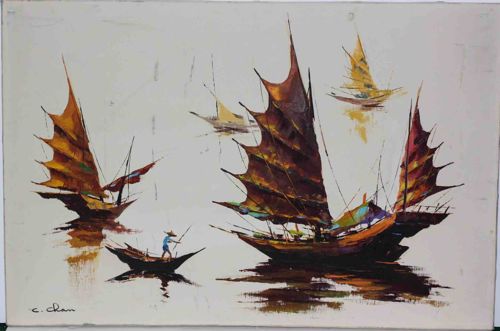
Mid-Century Modern Junks at Sea Oil Painting by C. Chan

Submitted photo of Mid-Century Modern Junks at Sea Oil Painting by C. Chan
Photo submitted by the user — not generated by AI

User's notes

Unknown artist, untitled artwork

These notes were written by the person who submitted this item. Appraiser.AI has not verified them, and the AI's identification and estimate may rely on them.

AI Estimated Value

Not an official valuation

$450 - $700

AI estimate as of March 9, 2026 · verify with a professional before acting

AI-Generated · Verify before acting

Everything on this page is generated by AI for informational purposes only. AI can make mistakes — the AI may misidentify items or misattribute them (artist, maker, brand, designer, origin, era). This is not an official valuation and should not be used for insurance, sale, tax, estate, legal, or lending purposes — or any decision requiring a certified appraisal. It is not an authoritative claim about any person, brand, or rights holder — do not share or rely on it as a factual statement about a third party. Always consult qualified professionals before making financial decisions.

This analysis also relies on unverified notes provided by the user, which may be incomplete or inaccurate and could affect the result.

Read the full disclaimer

AI Item Analysis

This is an original oil painting on canvas or board depicting traditional Chinese junk ships floating in calm waters. The artwork measures approximately in a landscape orientation and is executed in a Mid-Century Modern decorative style characterized by heavy impasto and palette knife techniques. The color palette features a contrast of neutral cream and off-white in the background against rich, warm tones of burnt orange, sienna, ochre, and deep crimson in the sails and hulls of the ships. Small accents of turquoise and blue are visible, particularly in the clothing of a lone fisherman standing in a small sampan in the foreground. The painting is signed 'C. Chan' in the lower left corner in a lowercase cursive script. This type of artwork was highly popular in the 1960s and 1970s and is typical of the 'Hong Kong harbor' sub-genre. The construction shows thick layers of paint that provide a three-dimensional texture to the jagged sails and the water's reflections. Visible condition issues appear minimal but include some mild surface dirt and likely very fine age-related crazing in the thicker impasto sections. The overall craftsmanship is consistent with high-quality commercial decorative art of the mid-20th century, utilizing gestural, confident strokes to create movement and atmosphere without meticulous detail.


AI Appraisal Report

I have conducted a visual examination of the oil painting 'Junks at Sea' attributed to C. Chan. This piece is a quintessential example of mid-century modern (MCM) commercial decorative art, likely produced in Hong Kong during the 1960s. The artist 'C. Chan' is a well-documented pseudonym or studio name associated with high-quality export art of this era. The use of heavy impasto and palette knife work is skillfully executed, creating a desirable 3D texture that collectors of vintage MCM decor find highly appealing. Condition-wise, the painting presents well. The impasto exhibits the expected micro-crazing consistent with age, but there is no evidence of significant paint loss or delamination. The color saturation remains vibrant, particularly the burnt oranges and ochres. Market demand for Hong Kong harbor scenes has seen a steady resurgence alongside the MCM revival, especially for larger landscape formats that serve as focal points in period-appropriate interiors. Comparables for C. Chan works typically range from $300 for smaller, less detailed scenes to over $800 for large-scale, high-texture compositions in original period frames. The value is limited by the fact that this is a production-style artwork rather than a unique piece by a listed fine artist with gallery pedigree. Limitations: My assessment is based on high-resolution digital imagery. A physical inspection would be required to verify the substrate integrity and rule out hidden repairs under UV light. Full authentication of the paint's chemical composition or provenance documentation is generally not performed for decorative works of this class, as the 'C. Chan' signature serves more as a stylistic brand than a singular identity.

Keep exploring

More fine art - paintings appraisals

Get your items appraised

Instant AI-powered appraisal estimates from a photo

Browse More Appraisals