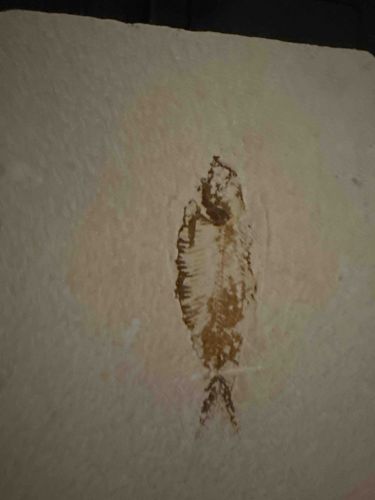
Knightia eocaena Fossil Fish
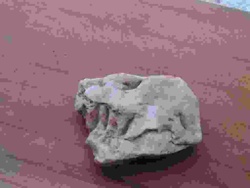
This specimen is a fossilized Knightia eocaena, a freshwater herring-like fish, preserved in a light cream-colored limestone matrix. The fossil originates from the Eocene-era Green River Formation in Wyoming, USA, dating to approximately 52 million years old. The specimen is displayed in a vertical orientation within the rectangular stone slab. Physically, the fossil remains show deep brown mineralization that contrasts sharply against the pale sediment. The skeleton exhibit is moderately complete, demonstrating clear rib structures, a visible vertebral column, and a forked caudal (tail) fin. The skull region appears somewhat crushed or indistinct, which is common for this type of preservation. The surrounding matrix is roughly textured with a noticeable orange-hued circular stain or 'halo' around the specimen, likely caused by mineral leaching or oxidation during the fossilization process or subsequent preparation steps. The slab appears to have been trimmed with straight edges, indicating it has been commercially prepared for retail or private collections. Condition-wise, the specimen shows no significant cracks in the stone, though the detail of the soft tissue and individual scales is lower compared to museum-grade specimens. The craftsmanship of the excavation is standard for commercial fossils, providing a clear but rustic look at the prehistoric remains.
AI-Generated Appraisal Disclaimer
Estimated Value
$45 - $75
Basic Information
Category
Paleontology and Natural History
Appraised On
March 22, 2026
Estimated Value
$45 - $75
Additional Details Provided By Owner
User Provided Information
Fish fossil i have had it for around 2 years
Item Description
This specimen is a fossilized Knightia eocaena, a freshwater herring-like fish, preserved in a light cream-colored limestone matrix. The fossil originates from the Eocene-era Green River Formation in Wyoming, USA, dating to approximately 52 million years old. The specimen is displayed in a vertical orientation within the rectangular stone slab. Physically, the fossil remains show deep brown mineralization that contrasts sharply against the pale sediment. The skeleton exhibit is moderately complete, demonstrating clear rib structures, a visible vertebral column, and a forked caudal (tail) fin. The skull region appears somewhat crushed or indistinct, which is common for this type of preservation. The surrounding matrix is roughly textured with a noticeable orange-hued circular stain or 'halo' around the specimen, likely caused by mineral leaching or oxidation during the fossilization process or subsequent preparation steps. The slab appears to have been trimmed with straight edges, indicating it has been commercially prepared for retail or private collections. Condition-wise, the specimen shows no significant cracks in the stone, though the detail of the soft tissue and individual scales is lower compared to museum-grade specimens. The craftsmanship of the excavation is standard for commercial fossils, providing a clear but rustic look at the prehistoric remains.
Related Tags
Get Your Items Appraised
Instant estimates of your treasures with AI-powered instant appraisals