AI estimate as of August 11, 2025 · verify with a professional before acting
AI-Generated · Verify before acting
Everything on this page is generated by AI for informational purposes only. AI can make mistakes — the AI may misidentify items or misattribute them (artist, maker, brand, designer, origin, era). This is not an official valuation and should not be used for insurance, sale, tax, estate, legal, or lending purposes — or any decision requiring a certified appraisal. It is not an authoritative claim about any person, brand, or rights holder — do not share or rely on it as a factual statement about a third party. Always consult qualified professionals before making financial decisions.
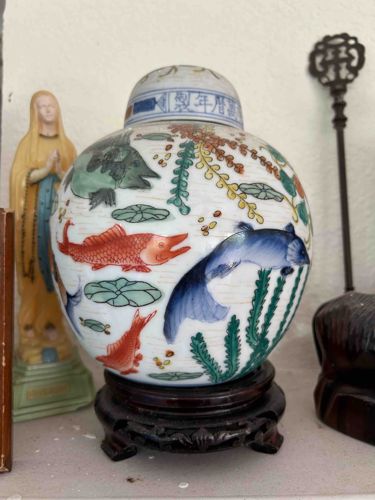
The item is a round-bodied, lidded jar, commonly referred to as a ginger jar, made of porcelain. It is presented on a fitted, dark, possibly rosewood or similar hardwood, carved stand with four feet. The jar features a vibrant polychrome enamel decoration, primarily depicting a fish and aquatic plant motif. Several stylized red and blue fish of varying sizes are depicted swimming amidst green aquatic plants and floating lotus pads. The background is a crisp white porcelain. The coloring of the fish is distinct, with some appearing solid red and others a rich blue with lighter accents. The enamel application appears vibrant and well-preserved. The lid is also porcelain and is painted with blue and white designs, including what appears to be a reign mark or signature in blue script around its rim. The characters on the lid are difficult to fully decipher from the image, but suggest a manufacturing detail. The jar itself has a gently curved, ovoid shape, tapering slightly towards the base and neck to accommodate the lid. There are no immediately obvious chips or cracks visible on the main body or lid from the provided image. The surface appears to have a subtle sheen indicating a glazed finish. The overall condition appears to be good for its presumed age, with only typical minor surface wear expected from handling and display. The craftsmanship suggests a hand-painted application, indicating traditional manufacturing techniques. Given the style, decoration, and a discernible reign mark on the lid, this jar likely dates to a Chinese dynastic period, possibly Qing Dynasty (17th to early 20th century), and represents a classic example of export porcelain. The quality of the porcelain and the intricacy of the painted details suggest it was a piece of some value and not mass-produced novelty.
AI Appraisal Report
Upon visual examination of the provided image, I assess this Chinese polychrome porcelain ginger jar with fish and aquatic motif to be in remarkably good condition. The vibrant enamel decoration, particularly the red and blue fish amidst green aquatic plants, appears well-preserved with excellent color saturation, suggesting minimal fading or wear. The white porcelain ground is crisp, and no immediate chips, cracks, or significant restoration are visible, indicating careful handling and display over time. The craftsmanship, evident in the hand-painted details and overall form, points to a traditional manufacturing technique rather than mass production. The presence of a potential reign mark or signature on the lid, though indecipherable from the image, strongly suggests an authentic piece from a specific Chinese dynastic period, likely the Qing Dynasty, aligning with classic export porcelain styles.
In terms of market conditions, comparable antique Chinese porcelain ginger jars with well-preserved polychrome decoration, especially those showcasing popular aquatic motifs and displaying reign marks, generally command strong interest. Demand for such pieces remains relatively robust among collectors of Asian art and antiques. While not exceedingly rare, a piece in this condition and apparent quality is uncommon. The primary factors impacting its value are its excellent condition, the vibrant and detailed enamel work, and the implied authenticity from the style and potential reign mark.
However, it is crucial to state that an definitive authentication and precise dating cannot be made from an image alone. To fully authenticate this piece, an in-person examination is critical to assess the porcelain body, glazes, and application of enamels microscopically. Physical inspection would also allow for a clear deciphering and verification of the reign mark. Furthermore, provenance documentation (e.g., historical sales records, prior ownership) would significantly enhance its verified authenticity and value. Scientific testing, such as thermoluminescence dating, could provide a more precise age, but is usually reserved for higher-value pieces or when authenticity is strongly disputed.