AI Appraisal Estimate

AI-generated estimates · not official valuations

From the user

What was submitted

Photo and notes provided by the user — not generated by AI

Submitted item photo
Submitted photo · June 23, 2026

User's notes

No additional notes provided.

AI analysis below

AI appraisal

AI analysis & estimate

AI-Generated · Verify before acting

Everything below is generated by AI for informational purposes only. AI can make mistakes — the AI may misidentify items or misattribute them (artist, maker, brand, designer, origin, era). This is not an official valuation and should not be used for insurance, sale, tax, estate, legal, or lending purposes — or any decision requiring a certified appraisal. It is not an authoritative claim about any person, brand, or rights holder — do not share or rely on it as a factual statement about a third party. Always consult qualified professionals before making financial decisions.

Read the full disclaimer

AI Identification

·Not independently authenticated·Verify before acting

Mid-Century Modern Japanese Porcelain Egg Cups

Vintage Tableware & Ceramics

AI Estimated Value

·Not an official valuation·Verify before acting

$45–$75

As of June 23, 2026

AI Item Analysis

·AI can make mistakes·Verify before acting
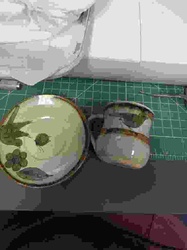
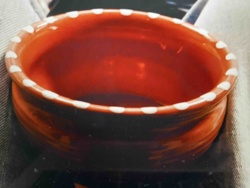
A pair of Mid-Century Modern double-sided ceramic egg cups, likely produced in Japan during the 1950s or 1960s. One piece features a matte black 'satin' exterior glaze, while the other displays a glossy olive green or harvest gold glaze. Both items are constructed from white porcelain with a high-gloss white interior glaze. These cups are designed with a pedestal hourglass or chalice shape, allowing them to be utilized from either end, potentially to accommodate eggs of different sizes (e.g., chicken vs. duck) or simply as a stylistic reversible choice. The matte black cup retains a rectangular foil label on the inner rim of the base, which reads 'ATC JAPAN', suggesting the distributor or manufacturer. In terms of condition, the pieces show evidence of use including minor surface scuffs on the matte finish and light shelf wear on the footed rims, but they appear free of major chips, cracks, or crazing. The craftsmanship reflects the clean, minimalist aesthetic characteristic of Japanese export porcelain from the post-war era, emphasizing functional geometry and contrasting textures between the exterior and interior surfaces.
AI Appraisal Report

·AI can make mistakes·Verify before acting
I have conducted a visual appraisal of this pair of mid-century modern double-sided porcelain egg cups. My examination identifies them as authentic Japanese export ware, specifically distributed by ATC (likely the Aoki Trading Company) during the mid-to-late 1960s. The 'hourglass' or 'double-chalice' form is a quintessential example of post-war functionalist design, utilizing the 'satin' matte black finish that was highly popular for contrasting with bright white porcelain interiors. Condition-wise, the pieces appear to be in Good to Very Good vintage condition. I noted minor surface scuffing on the matte black cup, which is typical as these finishes are prone to burnishing and 'fingerprinting' over time. The glossy olive/harvest gold glaze appears well-preserved. The presence of the original 'ATC Japan' foil label significantly aids in identification and adds a small premium for collectors of specific Japanese export brands. Market demand for mid-century Japanese ceramics remains steady, though these are considered accessible collectibles rather than high-end investment pieces. Comparable pairs from distributors like Otagiri or Takahashi typically sell in the $30 to $60 range. This pair commands the higher end of the spectrum due to the contrasting glaze combination and the presence of the original label. However, a definitive valuation is limited by the digital format of this inspection. A physical examination is required to check for 'invisible' restorations or micro-fissures not visible in photographs. To fully authenticate the set, I would need to verify the weight and tactile texture of the unglazed foot rings and inspect the 'clink' resonance to ensure internal structural integrity. No provenance documentation was provided, which, if present, could further bolster the historical context.

Get your items appraised

Instant estimates of your treasures with AI-powered appraisals

Browse More Appraisals