AI estimate as of December 2, 2025 · verify with a professional before acting
AI-Generated · Verify before acting
Everything on this page is generated by AI for informational purposes only. AI can make mistakes — the AI may misidentify items or misattribute them (artist, maker, brand, designer, origin, era). This is not an official valuation and should not be used for insurance, sale, tax, estate, legal, or lending purposes — or any decision requiring a certified appraisal. It is not an authoritative claim about any person, brand, or rights holder — do not share or rely on it as a factual statement about a third party. Always consult qualified professionals before making financial decisions.
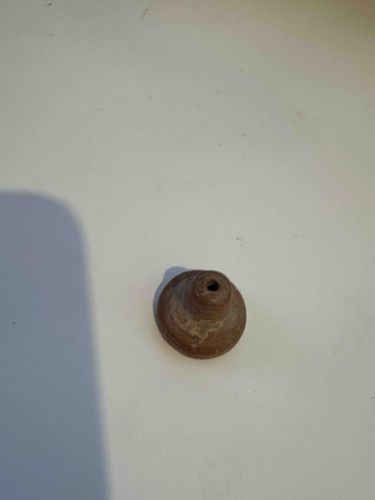
The item is a small, roughly conical object, appearing to be crafted from terracotta or a similar unglazed earthenware material. It features a flat, circular base and tapers upwards to a narrower, rounded top, creating a squat, bell-like or truncated cone shape. A central, cylindrical hole penetrates the entire length of the object, indicating its purpose as a spindle whorl, which would have been used to add weight and momentum to a spindle for spinning fiber into thread. The color is a muted, earthy brown with variations, possibly due to the natural color of the clay, uneven firing, or accumulated grime and patina over time. There are visible striations or concentric rings on the surface, especially evident around the tapered portion, which could be indicative of its method of manufacture, possibly shaped by hand or on a simple potter's wheel. The surface appears unpolished and somewhat rough, consistent with ancient or utilitarian pottery. The quality of craftsmanship seems rudimentary but functional, focusing on utility rather than elaborate decoration. The item displays significant wear and a rich patina, suggesting considerable age and prolonged use. There are no discernible maker's marks, inscriptions, or decorative elements. No apparent repairs, but some minor chipping or erosion on the edges and surface texture is possible due to its aged condition. Its small size further supports its identification as a handheld tool for textile production. The overall aesthetic points to an object of considerable historical interest, likely dating back to a period where handmade textiles were prevalent.
AI Appraisal Report
Based on my visual examination of the provided image, this terracotta spindle whorl appears to be an authentic archaeological artifact. Its form, material (unglazed earthenware with natural color variations), and the central hole are entirely consistent with known examples of ancient spindle whorls. The visible striations and rough, unpolished surface, along with the rich patina and signs of wear, strongly suggest considerable age and prolonged utilitarian use. The overall condition, while showing expected signs of age like minor chipping or erosion, is appropriate for an artifact of this type and likely period. No overt signs of modern fabrication or repair are evident.
Market conditions for such items are generally stable but with moderate demand. Spindle whorls are relatively common archaeological finds, particularly from regions with long histories of textile production. While historically significant as tools essential to ancient economies and daily life, their commonality and lack of intricate decoration, unique iconography, or association with a prominent culture or known site typically keep individual values modest. Comparable examples typically fall within the $30-$150 range, with more decorative or exceptionally preserved pieces fetching slightly higher sums. This piece's utilitarian nature and lack of distinctive features place it in the lower-to-mid range of this spectrum. Its rarity is low to moderate.
Factors significantly impacting value include its age, authenticity, and clear function as an ancient textile tool. However, the lack of specific provenance (e.g., excavation site, cultural attribution) and decorative elements limits its top-end value. A key limitation for full authentication from images alone is the inability to conduct tactile examination for weight, precise texture, and detailed surface anomalies. I cannot definitively date it or attribute it to a specific culture without further forensic analysis (e.g., thermoluminescence testing) or verifiable provenance documentation. A physical inspection would also confirm the material's composition and rule out any modern reproductions with high certainty.