These notes were written by the person who submitted this item. Appraiser.AI has not verified them, and the AI's identification and estimate may rely on them.
AI Estimated Value
Not an official valuation
$150-$250
AI estimate as of November 2, 2025 · verify with a professional before acting
AI-Generated · Verify before acting
Everything on this page is generated by AI for informational purposes only. AI can make mistakes — the AI may misidentify items or misattribute them (artist, maker, brand, designer, origin, era). This is not an official valuation and should not be used for insurance, sale, tax, estate, legal, or lending purposes — or any decision requiring a certified appraisal. It is not an authoritative claim about any person, brand, or rights holder — do not share or rely on it as a factual statement about a third party. Always consult qualified professionals before making financial decisions.
This analysis also relies on unverified notes provided by the user, which may be incomplete or inaccurate and could affect the result.
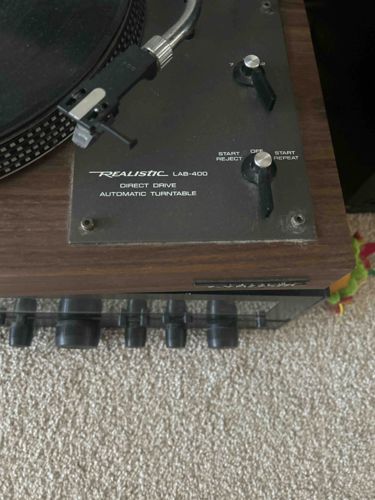
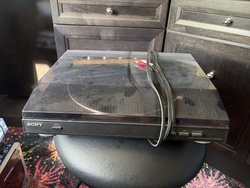
This item is identified as a Realistic LAB-400 Direct Drive Automatic Turntable. The turntable features a classic mid-to-late 20th-century design, likely from the 1970s or early 1980s, characteristic of the era's home audio equipment. The plinth, or base, appears to be constructed from wood with a visible dark brown wood grain finish, suggesting either solid wood or a wood veneer over particle board. The top control panel is made of a dark, likely metal or rigid plastic material, and houses the primary operational controls. Clearly visible is the Realistic branding, 'LAB-400', 'DIRECT DRIVE', and 'AUTOMATIC TURNTABLE' in white lettering on this panel. The unit features two chrome-topped lever-style switches; one controls 'START REJECT' and 'OFF', while the other manages 'START REPEAT'. These levers are black plastic, showing some dust accumulation around their bases, indicating general use and potentially a need for cleaning. The tonearm is visible with a silver-colored metal component transitioning into a black plastic headshell, which likely holds a cartridge and stylus (not clearly visible). The platter is dark, possibly black rubber or felt mat over a metal platter, with a ribbed edge. Below the main turntable unit, a row of at least five dark, presumably plastic, knob-like controls are visible, suggesting they are part of an integrated amplifier or receiver unit, or potentially controls for adjustments of the turntable itself, though their exact function is not discernible without further visual information. The overall condition suggests a used item with some wear consistent with its age, specifically dust and minor surface imperfections. The craftsmanship appears robust, typical of consumer electronics from this period, designed for durability and reliable performance. There are no obvious signs of major damage or repair from the provided images, but a detailed inspection would be necessary to assess fully.
AI Appraisal Report
Upon visual examination, this Realistic LAB-400 Direct Drive Automatic Turntable presents as a genuine example of vintage audio equipment from the late 1970s. The wood veneer plinth, control layout, and branding are all consistent with known models from this era. The unit appears to be in fair to good cosmetic condition, showing signs of use such as dust accumulation, but no major cracks, dents, or modifications are visible. The overall aesthetic is well-preserved for its age.
The current market for vintage turntables is robust, with significant demand for reliable, well-built models like the LAB-400, often regarded as one of RadioShack's best offerings. Recent sales of comparable LAB-400 units in similar, untested or 'as-is' cosmetic condition on online marketplaces typically range from $125 to $175. Fully serviced and tested units with a verified-functional cartridge command higher prices, often reaching $250 or more. The value of this specific unit is significantly impacted by its operational status. Key factors include the functionality of the direct drive motor, the automatic start/reject/repeat mechanisms, and the condition of the tonearm and its internal wiring. The presence and condition of the stylus and cartridge are critical variables; a new, quality cartridge alone can cost $50-$100.
My appraisal is limited by the inability to physically inspect and test the unit. A comprehensive assessment would require testing all electronic and mechanical functions, checking motor speed stability, and evaluating the cartridge for wear. Without powering on the device and playing a record, I cannot verify its full operational integrity, which is the primary driver of its value. Full authentication and a precise valuation would necessitate this hands-on testing.