AI Appraisal Estimate

AI-generated estimates · not official valuations

From the user

What was submitted

Photo and notes provided by the user — not generated by AI

Submitted item photo
Submitted photo · May 24, 2026

User's notes

No additional notes provided.

AI analysis below

AI appraisal

AI analysis & estimate

AI-Generated · Verify before acting

Everything below is generated by AI for informational purposes only. AI can make mistakes — the AI may misidentify items or misattribute them (artist, maker, brand, designer, origin, era). This is not an official valuation and should not be used for insurance, sale, tax, estate, legal, or lending purposes — or any decision requiring a certified appraisal. It is not an authoritative claim about any person, brand, or rights holder — do not share or rely on it as a factual statement about a third party. Always consult qualified professionals before making financial decisions.

Read the full disclaimer

AI Identification

·Not independently authenticated·Verify before acting

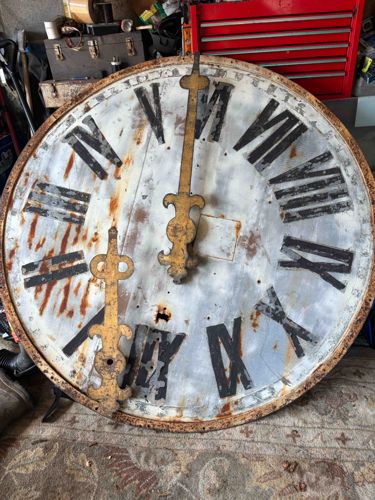
Antique Architectural Tower or Station Clock Face

Antiques / Architectural & Garden Elements

AI Estimated Value

·Not an official valuation·Verify before acting

$4,500 - $6,500

As of May 24, 2026

AI Item Analysis

·AI can make mistakes·Verify before acting
An exceptionally large, circular architectural clock face, likely salvaged from a public building such as a railway station, courthouse, or church tower. This industrial-scale timepiece is constructed from heavy-gauge sheet metal, possibly zinc or galvanized steel, which has been painted with a white ground and bold black Roman numerals. The hour and minute hands are oversized and feature ornate fleur-de-lis or trefoil-style decorative motifs, reminiscent of Gothic Revival or early Victorian styles from the late 19th to early 20th centuries. The hands appear to be made of cast metal and currently show a faded yellow or gold-tone paint. Regarding condition, the piece exhibits significant signs of authentic age and outdoor exposure, including extensive surface oxidation and rust blooms, particularly notable on the left side and around the outer rim. The paint on the numerals and the face is weathered, showing discoloration and a mottled greyish patina. There is a visible puncture or hole near the bottom center, possibly where a mounting bracket or the movement shaft was located. The item is currently unmounted and separated from its internal mechanical movement, suggesting it is being sold as a decorative architectural fragment or for restoration. The overall scale and honest wear indicate it was a functional exterior feature for several decades.

AI Appraisal Report

·AI can make mistakes·Verify before acting
Based on my visual examination of this large-scale architectural tower clock face, I have estimated a value reflective of its high demand within the current industrial design and 'salvage-chic' markets. The item exhibits authentic Victorian or early Edwardian Gothic Revival stylistic elements, specifically in the ornate trefoil hand design and the hand-painted Roman numerals. The heavy oxidation and weathered patina are considered 'honest wear' and are highly desirable to decorators seeking authentic architectural fragments. The scale suggests a significant provenance, likely a municipal building or railway station circa 1880–1910. Comparable sales for clock faces of this size (exceeding 4 feet) range significantly; however, the presence of the original ornate hands greatly elevates this piece over standard 'skeleton' or numeral-only dials. The primary value detractant is the lack of an associated mechanical movement and the mounting puncture, though these are standard for salvaged fragments. While the visual evidence of rust and mineral deposits strongly supports late 19th-century origin, I must note that this appraisal is based on photographic evidence alone. Full authentication would require a physical inspection to verify metal composition (zinc vs. steel) and layered paint analysis to ensure the numerals have not been significantly repainted in the modern era. Identifying the manufacturer—such as Seth Thomas or E. Howard & Co—via stamps on the rear of the hands or the central shaft would potentially double the estimated value. Provenance documentation regarding the building of origin is highly recommended to reach the upper echelon of the valuation range.

Get your items appraised

Instant estimates of your treasures with AI-powered appraisals

Browse More Appraisals