AI estimate as of July 19, 2025 · verify with a professional before acting
AI-Generated · Verify before acting
Everything on this page is generated by AI for informational purposes only. AI can make mistakes — the AI may misidentify items or misattribute them (artist, maker, brand, designer, origin, era). This is not an official valuation and should not be used for insurance, sale, tax, estate, legal, or lending purposes — or any decision requiring a certified appraisal. It is not an authoritative claim about any person, brand, or rights holder — do not share or rely on it as a factual statement about a third party. Always consult qualified professionals before making financial decisions.
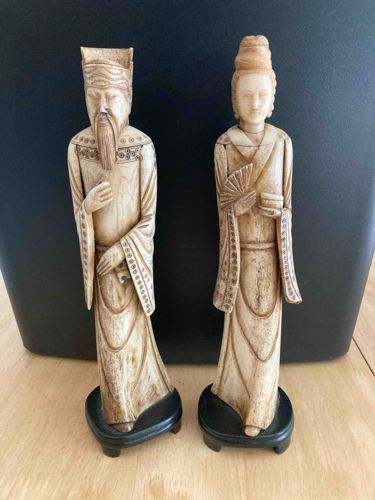
This pair of antique or vintage figurines depicts a male and female figure, likely representing scholars, deities, or imperial court members from East Asian culture, possibly Chinese or Japanese. Each figure stands on a separate, dark-colored, possibly lacquered or stained wood stand with small, squared feet. The figures themselves appear to be carved from a material that mimics ivory, exhibiting a creamy, aged off-white color consistent with bone, resin, or antique ivory (though further testing would be needed to confirm material and legality). The carving is intricate, showcasing fine details in the clothing folds, facial features, and hair/headdresses. The male figure has a long, flowing beard, a tall, elaborate hat, and is adorned with patterns on his robes, particularly around the collar and sleeves, suggesting embroidered designs. His hands are held together in front, with what appears to be a small object or gesture. The female figure has an elaborate coiled or stacked hairstyle, holds a fanned object (possibly a ceremonial fan or small scroll) in her right hand, and her robes also feature patterned borders. Both figures display a visible patina and slight discoloration consistent with age and handling. There are no obvious signs of significant damage like cracks or chips visible in the images, suggesting they are in good to very good condition for their apparent age. The craftsmanship indicates skilled artisan work, with detailed carving that brings out the textures of the garments and the expressions of the figures. The style points towards an earlier 20th-century or possibly late 19th-century period due to the carving quality and traditional East Asian depiction.
AI Appraisal Report
I have examined the provided image of the Pair of East Asian Figural Sculptures, depicting a male and female figure on wooden stands. Visually, the condition appears to be very good to excellent, showing no obvious chips, cracks, or significant repair, consistent with their apparent age. The intricate carving details on the robes, facial features, and headdresses suggest skilled craftsmanship. The material's creamy, aged off-white color and visible patina are indicative of bone, resin, or aged ivory.
Authenticity of the material, especially regarding ivory, cannot be definitively confirmed from images alone. An in-person examination, including tactile assessment and potentially microscopic analysis, would be necessary to distinguish between bone, resin, or genuine ivory. If confirmed as genuine antique ivory, CITES documentation would be essential for legal trade. Without such verification, I am appraising these based on them being quality reproductions in bone or resin, or pre-ban ivory that would necessitate advanced testing for legality determination.
The market for East Asian decorative arts remains steady, with pieces exhibiting fine craftsmanship and good condition commanding fair prices. Comparable items, typically late 19th to early 20th century, often sell in the mid-hundreds, particularly if the material is not definitively proven as ivory or if it's resin/bone. The pair's excellent condition and detailed artistry enhance their appeal. The demand for such figural sculptures is consistent among collectors of Asian antiques. Rarity is moderate; while finely detailed pairs are less common than single figures, they are not exceedingly rare.
Key factors impacting value include the actual material (ivory, bone, or resin), the period of creation, and definite provenance. Proving these are genuine antique ivory (pre-1947) would significantly increase their value, but also introduces legal complexities for sale. As such, for the purpose of this appraisal, I am valuing them conservatively, assuming they are either high-quality bone/resin or pre-ban ivory that would require extensive documentation and testing for legal sale.