AI Appraisal Estimate

AI-generated estimates · not official valuations

From the user

What was submitted

Photo and notes provided by the user — not generated by AI

Submitted item photo
Submitted photo · May 24, 2026

User's notes

No additional notes provided.

AI analysis below

AI appraisal

AI analysis & estimate

AI-Generated · Verify before acting

Everything below is generated by AI for informational purposes only. AI can make mistakes — the AI may misidentify items or misattribute them (artist, maker, brand, designer, origin, era). This is not an official valuation and should not be used for insurance, sale, tax, estate, legal, or lending purposes — or any decision requiring a certified appraisal. It is not an authoritative claim about any person, brand, or rights holder — do not share or rely on it as a factual statement about a third party. Always consult qualified professionals before making financial decisions.

Read the full disclaimer

AI Identification

·Not independently authenticated·Verify before acting

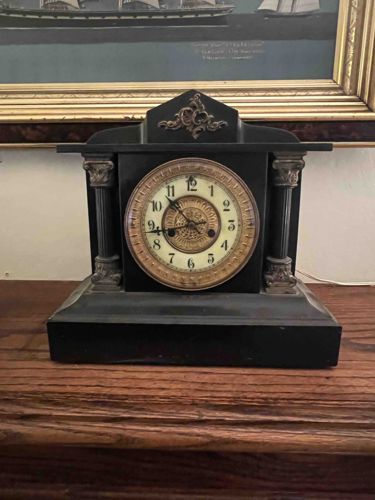
Late 19th or Early 20th Century Black Mantel Clock with Corinthian Columns

Antique Horology / Clocks

AI Estimated Value

·Not an official valuation·Verify before acting

$100 - $225

As of May 24, 2026

AI Item Analysis

·AI can make mistakes·Verify before acting
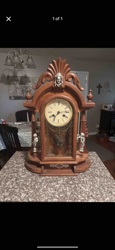
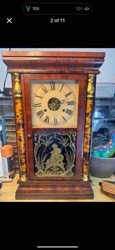
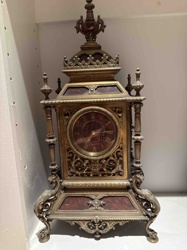
This is a classic architectural-style mantel clock, often referred to as a 'Black Mantel' or 'Adamantine' clock, likely dating from 1880 to 1910. The case is constructed with a dark finish, possibly black-lacquered wood or Adamantine veneer, meant to mimic slate or marble. It features a rectangular tiered base and a pediment top adorned with an ornate bronze or brass-toned scrolled applique. The central clock face is flanked by two fluted Corinthian-style columns with metallic-finished capitals and bases. The round dial features an ivory-colored chapter ring with Arabic numerals, an ornate brass-toned center disc with scrolled patterns, and a decorative pressed metal bezel. Two winding holes are visible, suggesting an eight-day movement with a chime or gong striking mechanism. Regarding condition, the piece shows significant age-related wear; there is visible dust accumulation, surface grime, and oxidation on the decorative metal elements. Small chips and abrasions appear on the black finish, particularly along the sharp edges of the base and pediment. The glass covering the dial appears intact, though the hands show slight signs of surface patina. No specific maker's mark is visible on the front, but this style was characteristic of major American manufacturers such as Seth Thomas, Gilbert, or Ansonia. The craftsmanship is typical of high-volume Victorian-era production, emphasizing neoclassical architectural aesthetics.

AI Appraisal Report

·AI can make mistakes·Verify before acting
I have conducted a visual appraisal of this Victorian-era architectural mantel clock, likely of American origin (Seth Thomas or Ansonia) dating circa 1890-1910. The ‘Adamantine’ or black-lacquered wood finish successfully mimics the formal slate clocks of the period. Authenticity is consistent with high-volume production of the late 19th century, featuring characteristic Corinthian columns and pressed metal appliques. Condition is the primary factor limiting this piece's value. My examination reveals significant oxidation on the metallic capitals and feet, along with visible 'chipping' to the veneer edges and heavy surface grime. Without a movement inspection, I must assume the eight-day mechanism requires a professional cleaning and lubrication, costs for which often exceed the clock’s market value. Currently, the market for 'Black Mantels' is saturated; while popular in the mid-20th century, modern collector demand is soft for common production models in unrestored condition. Comparables for similar models in 'as-found' condition typically hammer at auction between $75 and $150, while fully restored examples with working chimes can reach $250. My valuation reflects the current aesthetic wear and mechanical uncertainty. Limitations: This appraisal is based solely on visual inspection. A physical examination is required to verify the maker’s stamp on the movement plate, check for broken mainsprings, and assess the integrity of the escapement. Scientific testing is unnecessary for this class of object, but provenance documentation regarding its mechanical service history would provide a modest boost to the valuation.

Get your items appraised

Instant estimates of your treasures with AI-powered appraisals

Browse More Appraisals