AI Appraisal Estimate

AI-generated estimates · not official valuations

From the user

What was submitted

Photo and notes provided by the user — not generated by AI

Submitted item photo
Submitted photo · June 13, 2026

User's notes

No additional notes provided.

AI analysis below

AI appraisal

AI analysis & estimate

AI-Generated · Verify before acting

Everything below is generated by AI for informational purposes only. AI can make mistakes — the AI may misidentify items or misattribute them (artist, maker, brand, designer, origin, era). This is not an official valuation and should not be used for insurance, sale, tax, estate, legal, or lending purposes — or any decision requiring a certified appraisal. It is not an authoritative claim about any person, brand, or rights holder — do not share or rely on it as a factual statement about a third party. Always consult qualified professionals before making financial decisions.

Read the full disclaimer

AI Identification

·Not independently authenticated·Verify before acting

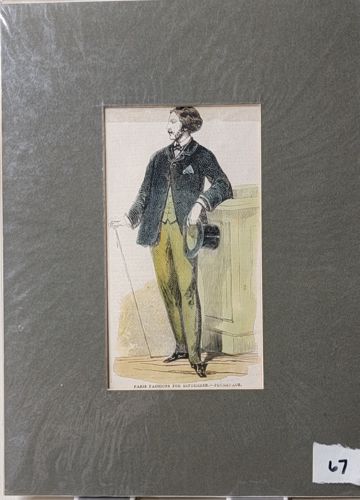
Antiquarian Hand-Colored Wood-Engraving - Paris Fashions for November

Art and Antiquarian Prints

AI Estimated Value

·Not an official valuation·Verify before acting

$65 - $95

As of June 13, 2026

AI Item Analysis

·AI can make mistakes·Verify before acting
This item is an original mid-19th-century antiquarian print, specifically a hand-colored wood engraving. The engraving depicts a Victorian gentleman and is titled at the bottom 'PARIS FASHIONS FOR NOVEMBER. - FRONTSIDE.' The central figure is dressed in formal attire characteristic of the 1850s-1860s, featuring a dark frock coat, a mustard-yellow waistcoat and trousers, a high neck-tie with a bow, and holding a silk top hat and a walking cane. The figure leans against a stone pedestal or mantel. The coloring appears to be manual watercolors applied over the black-ink engraved base. The paper shows age-appropriate light toning and minor foxing. The print is housed in a modern grey mat and is covered in a protective plastic sleeve, which shows some crinkling on the surface. Notable features include the intricate line work of the engraving, particularly in the shadow and texture of the velvet coat. The condition is generally good for its age, though some slight fading in the pigments may be present. The lettering at the base is clean and legible, indicating it was likely a plate from a fashion periodical or newspaper such as 'The Illustrated London News' or a similar contemporary journal. There are no visible maker's marks or artist signatures within the plate itself, but the craftsmanship of the engraving demonstrates the high level of technical skill characteristic of commercial illustration during the Victorian era.
AI Appraisal Report

·AI can make mistakes·Verify before acting
I have examined the digital representation of this mid-19th-century hand-colored wood engraving, titled 'Paris Fashions for November - Frontside.' The piece appears to be an authentic plate from a Victorian-era periodical, likely published between 1850 and 1865. The technical execution of the cross-hatching and stippling in the frock coat suggests a high-quality commercial engraving. The coloration shows the characteristic variation and slight bleeding associated with period hand-tinting rather than modern mechanical color processes. The condition is 'Good' for an ephemeral print. Notable light toning and minor foxing are visible, which is expected for high-acid paper of this age. The matting is modern and provides aesthetic value, though it does not contribute to the intrinsic value of the print itself. Market demand for individual Victorian fashion plates remains steady but modest, primarily driven by interior decorators and niche historical fashion collectors. The market is currently saturated with such plates, which limits rarity. Large-format engravings from 'The Illustrated London News' or 'The Gazette of Fashion' typically realize prices in the double-digit range unless they are part of a rare complete portfolio or have exceptional historical provenance. Limitation of Image-Based Appraisal: This assessment is based on visual analysis only. I cannot confirm the paper’s weight, watermark, or the presence of a 'plate mark'—factors critical to distinguishing an original 19th-century strike from a high-quality 20th-century offset lithograph. A physical examination under a jeweler's loupe is required to confirm the presence of ink ridges and to verify that the color is indeed hand-applied watercolor rather than printed dots. Access to the reverse side of the paper would also be necessary to check for 'ghosting' from the woodblock.

Get your items appraised

Instant estimates of your treasures with AI-powered appraisals

Browse More Appraisals