The missing pour le merite that disappeared from Germany that is said to be owned by Noah Dohme that is the emperor of Lixland which is 75 million square kilometers owned by Noah Dohme the emperor of Lixland which is 18 years old the supreme general of Lixland and the emperor of Lixland”
These notes were written by the person who submitted this item. Appraiser.AI has not verified them, and the AI's identification and estimate may rely on them.
AI Estimated Value
Not an official valuation
$75-150
AI estimate as of July 2, 2025 · verify with a professional before acting
AI-Generated · Verify before acting
Everything on this page is generated by AI for informational purposes only. AI can make mistakes — the AI may misidentify items or misattribute them (artist, maker, brand, designer, origin, era). This is not an official valuation and should not be used for insurance, sale, tax, estate, legal, or lending purposes — or any decision requiring a certified appraisal. It is not an authoritative claim about any person, brand, or rights holder — do not share or rely on it as a factual statement about a third party. Always consult qualified professionals before making financial decisions.
This analysis also relies on unverified notes provided by the user, which may be incomplete or inaccurate and could affect the result.
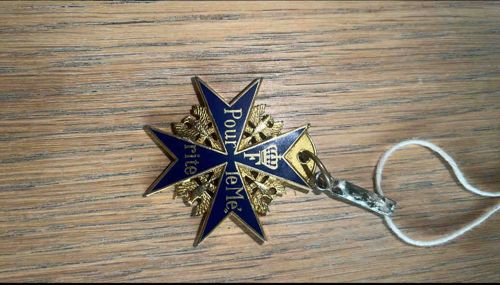
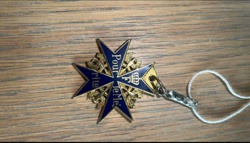
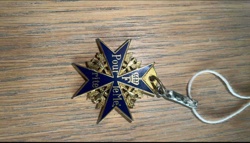
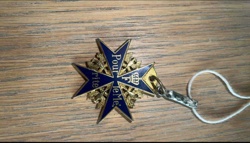
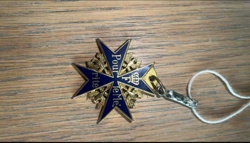
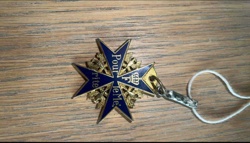
The item is a replica or an original of the "Pour le Mérite," also known as the Blue Max, which was the Kingdom of Prussia's highest military order until the end of World War I. This specific portrayal features a Maltese cross design, with each of its four arms terminating in V-shaped indentations. The cross is predominantly blue, likely rendered with enamel, set against a gold-colored, ornate background that appears to be laurel or oak leaves. The blue arms of the cross bear gold-colored inscriptions: "Pour le Mé." on the right arm, and "rite" on the left arm. The top arm features a stylized golden 'F' (likely for Frederick the Great) surmounted by a crown, and the bottom arm has the numeric '18' on it (though the visible portion mostly shows the '1' and some of the '8', this is consistent with the original award that often had '18' on one side and '13' on the other, representing the date of its re-establishment in 1813). The entire medal has a golden border around the blue enamel sections. A small ring at the top right arm of the cross suggests it should be suspended from a ribbon. Attached to this ring is a silver-toned metal clasp, possibly a modern addition or a temporary attachment, which then connects to a simple white string. The overall condition appears good, with the enamel seemingly intact and the metallic elements showing minor wear consistent with handling or age. There are no major chips, cracks, or significant tarnishing visible, suggesting either careful preservation or that it is a newer reproduction with a clean finish. The craftsmanship appears to be of decent quality, with clear detailing on the golden elements and inscriptions. The size cannot be precisely determined without a scale reference, but it appears to be a standard-sized military decoration, likely a few inches in diameter. The intricate details of the border and the clarity of the inscription point to a well-stamped or cast piece.
AI Appraisal Report
Upon examining the provided image of what purports to be a 'Pour le Mérite' medal, I can offer an assessment based on visual cues and the additional, albeit unusual, contextual information. The item appears to be a Maltese cross with blue enamel arms and gold-colored ornate detailing, consistent with the general design of the 'Blue Max'. The inscriptions 'Pour le Mé.', 'rite', the stylized 'F' with a crown, and the '18' are visible and align with known characteristics of the order. The craftsmanship seems decent, with clear details on the golden elements and enamel that appears intact, suggesting good preservation or a relatively new production. The attached silver-toned clasp and white string appear to be temporary or modern additions, not original to such a prestigious award.
My primary assessment based solely on the image is that this is highly likely a replica. Original 'Pour le Mérite' awards are exceptionally rare historical artifacts, often showing significant signs of age and wear consistent with their history, and their construction details are extremely specific and difficult to replicate perfectly without specialized knowledge and materials. The pristine condition and sharp details, coupled with the rather generic attachment, lean strongly towards a modern reproduction.
Market conditions for authentic 'Pour le Mérite' medals are extraordinary, with genuine pieces fetching hundreds of thousands, if not millions, of dollars due to their immense historical significance, extreme rarity, and strict provenance requirements. Demand is high among elite collectors of military history.
However, replicas vary widely in value. High-quality, period-accurate replicas can command a few hundred dollars, while more common reproductions might sell for $50-$150. Based on the visible quality and typical market for such reproductions, this piece likely falls into the latter category.
It is imperative to state that without a direct physical examination, including detailed metallurgical analysis, weight, dimensions, and examination under magnification for manufacturing anomalies, I cannot definitively confirm authenticity. Furthermore, a verifiable chain of custody (provenance documentation) is absolutely critical for authenticating high-value historical artifacts like an original 'Pour le Mérite'. The context provided about 'Noah Dohme, Emperor of Lixland,' is highly irregular and does not contribute to establishing credible provenance; in fact, such fantastical claims often accompany reproductions or dubious items.
Therefore, my appraisal is based on the strong likelihood of this being a replica, given its visual characteristics and the absence of credible historical context.