AI estimate as of October 19, 2025 · verify with a professional before acting
AI-Generated · Verify before acting
Everything on this page is generated by AI for informational purposes only. AI can make mistakes — the AI may misidentify items or misattribute them (artist, maker, brand, designer, origin, era). This is not an official valuation and should not be used for insurance, sale, tax, estate, legal, or lending purposes — or any decision requiring a certified appraisal. It is not an authoritative claim about any person, brand, or rights holder — do not share or rely on it as a factual statement about a third party. Always consult qualified professionals before making financial decisions.
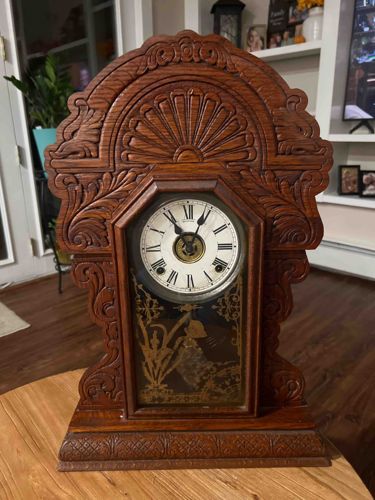
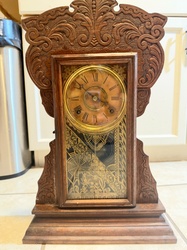
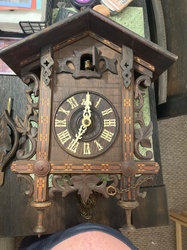
This is a substantial mantel clock, likely dating from the late 19th or early 20th century, specifically within the Victorian or early Arts and Crafts period, given its ornate carving and use of oak. The primary material is a rich, medium-toned oak wood, exhibiting a prominent grain pattern. The clock features an elaborate, highly decorative wooden case with extensive carving. The top section showcases a prominent sunburst or radial fan motif, flanked by stylized acanthus leaf or scrollwork carvings that extend down the sides, forming substantial brackets. The overall form is architectural and symmetrical, with the clock face set within a rectangular frame that is itself bordered by an octagonal bezel. The clock face is white or off-white, featuring black Roman numerals for hours and what appear to be black spade or 'Breguet' style hands. It has a brass-colored inner ring or bezel surrounding the hand shafts, indicating quality. Below the clock face, there is a glass panel with reverse-painted or stenciled decoration in shades of gold or bronze, depicting what appears to be a landscape scene with stylized foliage and possibly a figure or animal. This lower glass panel provides a glimpse into the pendulum chamber, though the pendulum itself is not clearly visible. The base of the clock is broad and solid, featuring a repetitive geometric or possibly basketweave carving along its front edge, providing visual weight and stability. The wood shows a warm, aged patina consistent with its estimated age. There are no obvious major damages like cracks or significant chips visible, though minor surface wear, small scratches, or darkening of the finish in recessed carved areas from age and handling would be expected. The craftsmanship is indicative of mass-produced but still highly detailed ornamental woodworking typical of the era, suggesting good-to-high quality for its time.
AI Appraisal Report
Based on my visual examination of the provided image, this Victorian Era Carved Oak Mantel Clock appears to be a good example of late 19th/early 20th-century American or English clockmaking. The elaborate oak carving, featuring a prominent sunburst motif, acanthus leaves, and geometric patterns on the base, is characteristic of the period, particularly appealing to Arts and Crafts or Aesthetic movement tastes. The overall condition appears to be good for its age, with a well-preserved aged patina. I observe no major damage like significant cracks or chips, though typical surface wear, minor scratches, and darkening in carved recesses would be expected and enhance its antique charm. The white dial with Roman numerals and spade hands, along with the brass-colored inner bezel, indicates quality. The reverse-painted glass panel below the dial is a charming detail, adding to its decorative appeal.
Market conditions for mantel clocks of this type are generally stable, with a moderate but consistent demand from collectors and decorators seeking period pieces. However, mass-produced examples (even high-quality ones like this appears to be) command less than highly rare or artisanal pieces. Comparables typically range from $200-$600 depending on condition, movement quality, and geographic market. This clock's substantial size and detailed carving place it at the higher end of this range. Rarity is not a significant factor here, as many similar clocks were produced. Factors positively impacting value include the seemingly good condition, elaborate carving, and complete appearance.
Limitations in authenticity verification from an image alone are significant. While the case strongly suggests the period, without physical inspection, I cannot confirm the originality or condition of the clock's movement. An in-person examination would be crucial to determine the movement's manufacturer, condition, whether it is original to the case, and if it is in working order. Provenance documentation, such as original sales receipts or family history, would further authenticate its history. Scientific testing is generally not required for such clocks unless there are doubts about the wood or paint, which is not indicated here. My appraisal value assumes the movement is original and in reasonable, restorable, or working condition.