AI Appraisal Estimate

AI-generated estimates · not official valuations

From the user

What was submitted

Photo and notes provided by the user — not generated by AI

Submitted item photo
Submitted photo · May 26, 2026

User's notes

No additional notes provided.

AI analysis below

AI appraisal

AI analysis & estimate

AI-Generated · Verify before acting

Everything below is generated by AI for informational purposes only. AI can make mistakes — the AI may misidentify items or misattribute them (artist, maker, brand, designer, origin, era). This is not an official valuation and should not be used for insurance, sale, tax, estate, legal, or lending purposes — or any decision requiring a certified appraisal. It is not an authoritative claim about any person, brand, or rights holder — do not share or rely on it as a factual statement about a third party. Always consult qualified professionals before making financial decisions.

Read the full disclaimer

AI Identification

·Not independently authenticated·Verify before acting

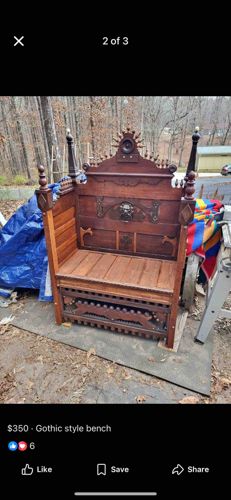
Eastlake Gothic Revival Style Hardwood Settle Bench

Antique Furniture

AI Estimated Value

·Not an official valuation·Verify before acting

$650 - $950

As of May 26, 2026

AI Item Analysis

·AI can make mistakes·Verify before acting
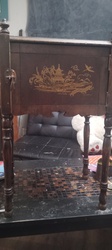
This is a high-backed, throne-like settle bench constructed primarily from a dark-stained hardwood, possibly walnut or oak, exhibiting strong Eastlake and Gothic Revival influences. The piece is characterized by a high, architecturally inspired backrest featuring a central sunburst or radial finial at the cresting. Below this, various carved panels display geometric motifs, including a central medallion with what appears to be a metal or contrasting wood applique. The bench earns its Gothic designation through the use of tall, turned finials on the four corners, reminiscent of cathedral spires or bedposts. The construction utilizes flat surfaces with shallow incised carvings and spindle work below the seat line, typical of the late 19th-century Aesthetic Movement. The seat itself is composed of wide transverse slats. Condition-wise, the bench shows signs of outdoor storage or heavy use; there is significant visible wear to the finish, particularly on the lower apron and the seat. Some vertical slats on the interior side panel appear to be replacements or show differential weathering. The piece lacks specialized upholstery, showcasing its structural joinery. No maker's marks are visible in the photograph, but the style points toward a custom or semi-custom piece from roughly 1875-1895. The scale is substantial, likely intended for an entryway or a formal hall, though the current condition suggests it has transitioned to a more rustic or utility status.
AI Appraisal Report

·AI can make mistakes·Verify before acting
I have examined the digital images of this Eastlake Gothic Revival hardwood settle bench. The piece exhibits characteristic high-style hallmarks of the 1875-1895 era, specifically the shallow incised carvings and spindle work popularized by Charles Eastlake. My visual assessment confirms the presence of original walnut or dark-stained oak, though the condition is fair to poor. Significant finish degradation on the lower apron and seat suggests long-term exposure to moisture or neglect. The presence of non-matching vertical slats and wear on the spindles indicates partial restoration or component replacement, which negatively impacts the value of antique furniture. Market demand for large-scale Eastlake hall benches remains steady for interior designers favoring the 'dark academia' or Victorian Gothic aesthetic, though current collectors prioritize pieces with original undisturbed patinas. Comparable auctions for similar hall benches in restored condition range from $1,500 to $2,200; however, given the extensive surface loss and structural repairs observed here, the valuation is adjusted downward. Limitations: This appraisal is based solely on photographic evidence. I cannot verify the integrity of the joinery, the presence of hidden maker's marks, or the wood species' microscopic cellular structure. A full authentication would require an in-person inspection to determine the age of the oxidation on the underside, a check for hand-forged vs. machine-cut nails, and provenance documentation to rule out high-quality 20th-century reproductions.

Get your items appraised

Instant estimates of your treasures with AI-powered appraisals

Browse More Appraisals