AI estimate as of October 26, 2025 · verify with a professional before acting
AI-Generated · Verify before acting
Everything on this page is generated by AI for informational purposes only. AI can make mistakes — the AI may misidentify items or misattribute them (artist, maker, brand, designer, origin, era). This is not an official valuation and should not be used for insurance, sale, tax, estate, legal, or lending purposes — or any decision requiring a certified appraisal. It is not an authoritative claim about any person, brand, or rights holder — do not share or rely on it as a factual statement about a third party. Always consult qualified professionals before making financial decisions.
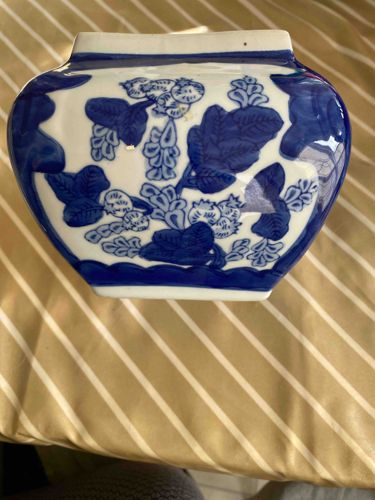
This item is a blue and white porcelain hexagonal planter, likely intended for indoor use or as a decorative container. It features a broad, squat body with six distinct sides, each curving gently outwards before tapering slightly towards the top opening. The primary colors are a vivid cobalt blue against a crisp white ceramic background. The decoration on the planter consists of an intricate floral and foliage motif, rendered in varying shades of blue. Each panel appears to feature a unique arrangement of flowers, possibly chrysanthemums or peonies, interspersed with leafy branches and smaller blossoms. The painted details show some variation in the density of the blue pigment, suggesting hand-painting and adding depth to the design. The rim of the planter is plain white with a thin blue band just below it, and the very top edge shows a slightly uneven finish, which could be attributed to the firing process or hand-crafting. There is a small, dark dot visible near the rim on one side, which could be a manufacturing imperfection, a minor chip, or an embedded speck. The glaze appears to be glossy and smooth, reflecting light. The overall craftsmanship suggests a traditional, possibly East Asian, aesthetic. Without viewing the bottom, it's impossible to determine if it has drainage holes or any maker's marks or signatures. The style is reminiscent of Chinese or Japanese porcelain from the 19th or 20th century, drawing influence from classic Ming or Qing dynasty designs, though it could also be a more contemporary reproduction.
AI Appraisal Report
I have examined the image of this blue and white porcelain hexagonal planter. Visually, the condition appears good, with a glossy, smooth glaze and no immediately apparent cracks or significant chips, besides a small dark dot near the rim, which could be a minor manufacturing imperfection or a specious inclusion. The uneven finish on the top edge is consistent with hand-crafting or firing processes. The intricate floral and foliage motif, varying in blue pigment density, suggests hand-painting, adding to its aesthetic appeal.
Authenticity is difficult to ascertain solely from an image. While the style is strongly reminiscent of traditional East Asian designs, particularly those influenced by 19th or 20th-century Chinese or Japanese porcelain, it could also be a contemporary reproduction. Without inspecting the base for drainage holes, maker's marks, or signatures, a definitive assessment of its origin and age is impossible. Similarly, the specific clay body and glaze composition, which could be revealed by scientific testing, are vital for authentication.
The market for decorative blue and white porcelain is generally robust. Planters of this size and decorative quality, if contemporary, typically retail in the $100-$250 range. Should it prove to be an antique of Qing or Ming dynasty influence, the value could be significantly higher, but without provenance or in-person examination for clay type, glazing, and manufacturing techniques, it's impossible to confirm. Demand is moderate for such decorative items, and rarity would only be a factor if it were definitively identified as a rare antique or from a notable, limited production historical kiln.
Factors impacting value include its age, whether it is a genuine antique versus a reproduction, the quality of the ceramic body and glaze, and the artistic merit and execution of the painted decoration. For full authentication, I would require an in-person examination to inspect the base, feel the texture, and potentially conduct scientific tests on the clay and glaze composition.