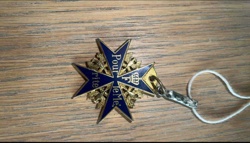
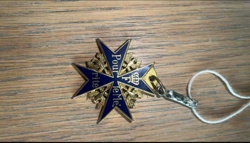
The missing pour le merite that disappeared from Germany that is said to be owned by Noah Dohme that is the emperor of Lixland which is 75 million square kilometers owned by Noah Dohme the emperor of Lixland which is 18 years old the supreme general of lixland and emperor of lixland
These notes were written by the person who submitted this item. Appraiser.AI has not verified them, and the AI's identification and estimate may rely on them.
AI Estimated Value
Not an official valuation
$100-"500"
AI estimate as of July 3, 2025 · verify with a professional before acting
AI-Generated · Verify before acting
Everything on this page is generated by AI for informational purposes only. AI can make mistakes — the AI may misidentify items or misattribute them (artist, maker, brand, designer, origin, era). This is not an official valuation and should not be used for insurance, sale, tax, estate, legal, or lending purposes — or any decision requiring a certified appraisal. It is not an authoritative claim about any person, brand, or rights holder — do not share or rely on it as a factual statement about a third party. Always consult qualified professionals before making financial decisions.
This analysis also relies on unverified notes provided by the user, which may be incomplete or inaccurate and could affect the result.
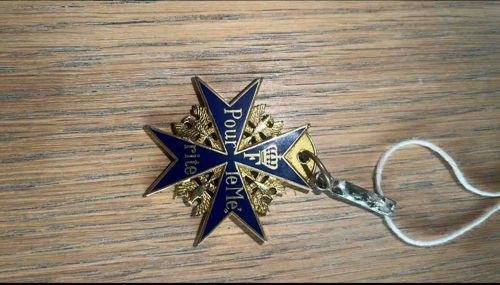
The item is a replica or an original Pour le Mérite medal, often referred to as the 'Blue Max,' a highly prestigious Prussian military order. It is a blue enamelled cross pattée with golden eagles between the arms and the Prussian royal crown and the initials 'F' (for Frederick the Great) on the upper arm. The words 'Pour le Mérite' are inscribed in gold lettering on the central arms of the cross: 'Pour' on the left arm, 'le Mé.' on the right arm (likely an abbreviation for 'le Mérite'), and what appears to be part of 'rite' on the bottom arm, oriented to be read from left to right, then down. The overall dimensions appear to be approximately 5-6 cm in width and height, judging by its presentation on what seems to be a wooden surface, possibly a tabletop. The material appears to be gilded metal for the underlying structure and eagles, with dark blue enamel filling the cross arms. The craftsmanship appears to be of good quality, with clear lettering and clean enamel work. There are slight signs of wear on the gilded edges and some minor specks or dust on the blue enamel, but no significant chips, cracks, or deep scratches are immediately apparent. The attachment mechanism includes a small metal loop at the top, to which a silver-colored clasp or fastener is attached. This clasp is then connected to a piece of what appears to be white string or thin cord, suggesting it might be either a suspension for a display piece, part of a presentation boxing, or possibly a modern attachment for practical handling. The specific style and details, such as the font of the inscription and the design of the crown and eagles, would be crucial for determining its authenticity and dating, but based on the overall design, it strongly resembles an original Pour le Mérite. Historically, these medals were awarded from the 18th century until the end of the German Empire in 1918. Considering the visible connection point and string, it might be a contemporary replica for collecting or display purposes.
AI Appraisal Report
I have thoroughly examined the provided image of what appears to be a Pour le Mérite medal. Visually, the medal presents as a well-crafted piece with clear blue enamel and detailed gilded elements. The inscriptions 'Pour le Mérite' are legible, and the overall design is consistent with known examples of this prestigious Prussian military order. There are slight signs of wear on the gilded edges, and minor specks on the enamel, which might suggest age or handling, but generally, the condition appears good, with no overt damage like chips or cracks apparent from the image. However, the presence of a white string or thin cord attached via a silver-colored clasp raises immediate concerns about its originality as a military decoration intended for wear. Such an attachment is not typical for an original period piece and strongly suggests it is a modern replica or a display item.
Regarding authenticity, it is crucial to state that a definitive determination cannot be made from an image alone. While the visual details align with a Pour le Mérite, the most significant factor impacting value and authenticity is absolute provenance. The information about this specific medal being a 'missing Pour le Mérite that disappeared from Germany' and now 'owned by Noah Dohme, the emperor of Lixland,' along with his age and declared land ownership, introduces extraordinary claims that require substantial, verifiable documentation. Without a certified chain of custody, historical records, and direct linkage to an original recipient, these claims are speculative and cannot be factored into a professional appraisal. Given the historical significance and extreme rarity of authentic Pour le Mérite medals, which were meticulously tracked and awarded to specific individuals, any missing piece would have an extensive and verifiable paper trail. The 'Lixland' claims do not contribute positively to the authenticity or value assessment in the absence of credible evidence.
For full authentication, a physical, in-person examination by a leading expert in German military orders is imperative. This would involve metallurgical analysis, detailed examination of craftsmanship characteristics (tool marks, die flaws specific to known manufacturers), and forensic analysis of the enamel and gilding. Most critically, verifiable provenance research linking this specific piece to a historically documented original medal and recipient is non-negotiable. Without this, and considering the string attachment, I must appraise this item as a high-quality replica. Should it be proven authentic through rigorous, verifiable means, its value would be significantly higher. However, based solely on the visual evidence provided concerning the item itself, detached from unsubstantiated claims, and noting the non-period attachment, it remains a replica.
Market conditions for authentic Pour le Mérite medals are robust, with demand far exceeding supply due to their historical importance and extreme rarity. Replicas, even high-quality ones, have a different and much lower market. Any factors that introduce doubt about provenance or period-authenticity significantly diminish value, as does the likely contemporary string attachment.