Hand-Woven Coiled Tray Basket
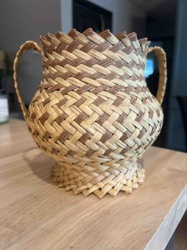
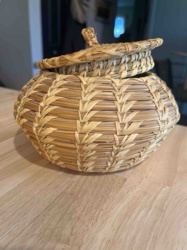
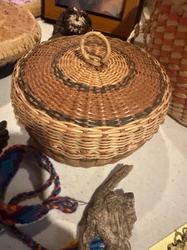
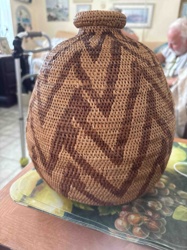
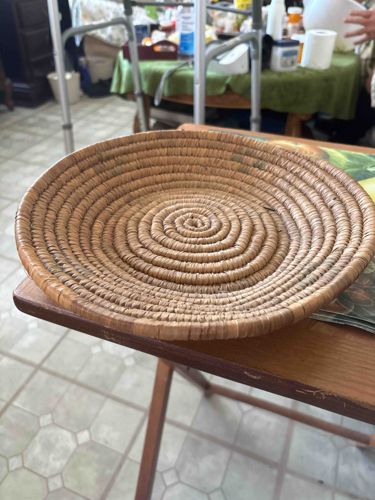
This item is a shallow, circular tray-style basket constructed using a traditional coiling technique. It features a continuous spiral of bundled plant fibers—likely grasses, reeds, or pine needles—tightly bound by a thin vertical wrapping of similar natural material. The basket exhibits a rich, warm honey-brown to tan color palette, which is characteristic of aged natural fibers. The center begins with a tightly wound spiral that graduates into wider coils toward the rim, showing a consistent and skilled weave. Physically, the basket appears to be approximately 10 to 12 inches in diameter with a low profile. There are no immediate visible maker's marks or signatures, which is common for indigenous or folk-art basketry. The condition shows a heavy patina consistent with age, featuring some localized darkening and surface grime, particularly on the outer rings. Some minor fraying of the wrapping fibers is visible along the rim and within the coils, but the overall structural integrity remains intact without significant breaks or unraveling. This style is often associated with Native American tribal traditions (such as Tohono O'odham or Hopi) or African weaving styles (like those from Rwanda or Ethiopia), likely dating to the mid-20th century. The craftsmanship is high, indicated by the uniformity of the coil thickness and the rhythmic spacing of the binding stitches.
AI-Generated Appraisal Disclaimer
Estimated Value
$250 - $400
Basic Information
Category
Antique Basketry / Folk Art
Appraised On
March 25, 2026
Estimated Value
$250 - $400
Item Description
This item is a shallow, circular tray-style basket constructed using a traditional coiling technique. It features a continuous spiral of bundled plant fibers—likely grasses, reeds, or pine needles—tightly bound by a thin vertical wrapping of similar natural material. The basket exhibits a rich, warm honey-brown to tan color palette, which is characteristic of aged natural fibers. The center begins with a tightly wound spiral that graduates into wider coils toward the rim, showing a consistent and skilled weave. Physically, the basket appears to be approximately 10 to 12 inches in diameter with a low profile. There are no immediate visible maker's marks or signatures, which is common for indigenous or folk-art basketry. The condition shows a heavy patina consistent with age, featuring some localized darkening and surface grime, particularly on the outer rings. Some minor fraying of the wrapping fibers is visible along the rim and within the coils, but the overall structural integrity remains intact without significant breaks or unraveling. This style is often associated with Native American tribal traditions (such as Tohono O'odham or Hopi) or African weaving styles (like those from Rwanda or Ethiopia), likely dating to the mid-20th century. The craftsmanship is high, indicated by the uniformity of the coil thickness and the rhythmic spacing of the binding stitches.
Related Tags
Get Your Items Appraised
Instant estimates of your treasures with AI-powered instant appraisals