Royal South-Holland (Zuid-Holland) Gouda Pottery Jardinière
Art Pottery / Dutch Ceramics

Royal South-Holland (Zuid-Holland) Gouda Pottery Jardinière

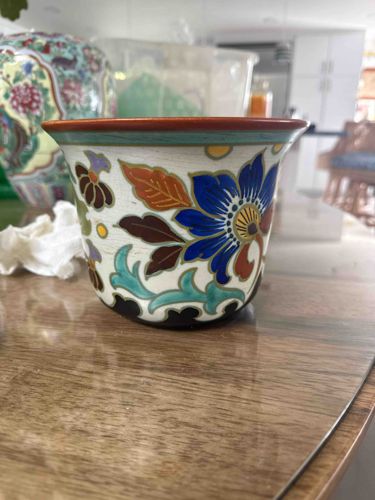
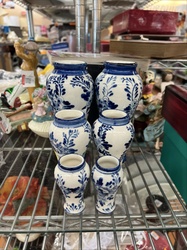
This is a hand-painted Dutch ceramic jardinière or cachepot, produced by the Royal South-Holland (Koninklijke Plateelbakkerij Zuid-Holland) factory in Gouda, Netherlands. The piece features the iconic 'Matte Gouda' finish, characterized by its non-reflective, velvety surface. The design exhibits a vibrant Art Nouveau or Art Deco influence, specifically the 'Rhodian' or 'Damascus' style patterns popular in the early 20th century. The central motif consists of a bold, stylized cobalt blue flower flanked by ochre, rust-brown, and turquoise acanthus leaves and abstract flourishes. The background is a crackled cream/off-white glaze, accented by a solid terracotta-orange rim and a dark, possibly black or deep olive, base band. Physically, the vessel has a flared rim and a tapered, rounded body typical of indoor planters. Notable craftsmanship is seen in the piped 'cloisonné' style outlines that separate the colored glazes. Visible condition issues include fine age-related crazing throughout the light-colored background, which is common for this type of earthenware. There are minor scuffs near the base, though no outward structural cracks or significant chips are visible from this angle. Based on the style and professional execution, this piece likely dates from the 1920s to the 1930s, a period when Dutch art pottery transitioned from delicate floral motifs to bolder, more graphic geometric and botanical expressions.
Estimated Value

$250 - $400

Basic Information

Category

Art Pottery / Dutch Ceramics

Appraised On

January 21, 2026

Estimated Value

$250 - $400

Additional Details Provided By Owner

User Provided Information

Gouda blurred royal

Item Description

This is a hand-painted Dutch ceramic jardinière or cachepot, produced by the Royal South-Holland (Koninklijke Plateelbakkerij Zuid-Holland) factory in Gouda, Netherlands. The piece features the iconic 'Matte Gouda' finish, characterized by its non-reflective, velvety surface. The design exhibits a vibrant Art Nouveau or Art Deco influence, specifically the 'Rhodian' or 'Damascus' style patterns popular in the early 20th century. The central motif consists of a bold, stylized cobalt blue flower flanked by ochre, rust-brown, and turquoise acanthus leaves and abstract flourishes. The background is a crackled cream/off-white glaze, accented by a solid terracotta-orange rim and a dark, possibly black or deep olive, base band. Physically, the vessel has a flared rim and a tapered, rounded body typical of indoor planters. Notable craftsmanship is seen in the piped 'cloisonné' style outlines that separate the colored glazes. Visible condition issues include fine age-related crazing throughout the light-colored background, which is common for this type of earthenware. There are minor scuffs near the base, though no outward structural cracks or significant chips are visible from this angle. Based on the style and professional execution, this piece likely dates from the 1920s to the 1930s, a period when Dutch art pottery transitioned from delicate floral motifs to bolder, more graphic geometric and botanical expressions.
Get Your Items Appraised

Instant estimates of your treasures with AI-powered instant appraisals

Browse More Appraisals