AI Appraisal Estimate

AI-generated estimates · not official valuations

From the user

What was submitted

Photo and notes provided by the user — not generated by AI

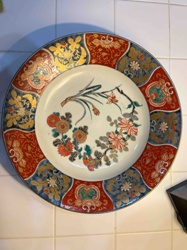
Submitted item photo
Submitted photo · June 8, 2026

User's notes

No additional notes provided.

AI analysis below

AI appraisal

AI analysis & estimate

AI-Generated · Verify before acting

Everything below is generated by AI for informational purposes only. AI can make mistakes — the AI may misidentify items or misattribute them (artist, maker, brand, designer, origin, era). This is not an official valuation and should not be used for insurance, sale, tax, estate, legal, or lending purposes — or any decision requiring a certified appraisal. It is not an authoritative claim about any person, brand, or rights holder — do not share or rely on it as a factual statement about a third party. Always consult qualified professionals before making financial decisions.

Read the full disclaimer

AI Identification

·Not independently authenticated·Verify before acting

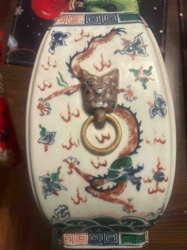
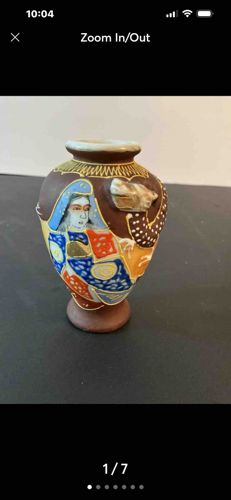
Japanese Satsuma Moriage Dragon Ware Bud Vase

Asian Antiques / Ceramics

AI Estimated Value

·Not an official valuation·Verify before acting

$45.00-$75.00

As of June 8, 2026

AI Item Analysis

·AI can make mistakes·Verify before acting
This is a small, baluster-shaped bud vase featuring traditional Japanese Satsuma styling with heavy moriage decoration. The piece is constructed from a matte, dark brown earthenware body, which provides a stark contrast to the vivid, raised enamel work. The primary decorative motif depicts a Shimazu-style figure, likely a male or Buddhist immortal, characterized by a pale face and intricate robes in shades of royal blue, orange, and yellow. To the right of the figure, a high-relief 'dragon ware' element is present, where a molded dragon's head and neck wrap around the shoulder of the vessel, accented with white slip dots to simulate scales. The neck of the vase is adorned with a gilded saw-tooth or 'moriage' collar. The craftsmanship utilizes the 'moriage' technique, which involves layering slip and enamel to create a three-dimensional, tactile effect on the surface. Visible condition issues include light surface dust and minor wear to the gilding on the rim and collar, consistent with a mid-20th-century origins, likely Taisho or early Showa period (circa 1920s-1950s). There are no immediate signs of significant cracking or structural failure, though the matte finish shows typical minor scuffing.
AI Appraisal Report

·AI can make mistakes·Verify before acting
I have virtually examined this Japanese bud vase, which appears to be a classic example of export-ware 'Dragon Ware' in the Satsuma style, likely dating from the mid-20th century (late Taisho to early Showa era). The piece utilizes the characteristic moriage technique, featuring high-relief slip application to create the dragon and the figural immortal. The matte 'chocolate' or dark brown ground is typical of mass-produced export ceramics from the 1930s-1950s intended for Western markets. The condition appears fair to good. I observe minor gilding loss on the rim and typical surface scuffing common to matte earthenware. While the moriage remains largely intact, these pieces are prone to 'flea bites' or chipping on the raised elements; a physical inspection would be required to ensure no structural cracks exist beneath the heavy decoration. Market-wise, there is a high volume of these pieces available, which limits rarity. They are often sought after for their tactile quality and decorative charm rather than investment potential. The lack of a visible maker's mark (e.g., 'Kushu' or 'Hayasi') suggests it may be a standard workshop production. IMPORTANT LIMITATIONS: This valuation is based solely on digital images. A full authentication would require an in-person examination to verify the clay's porosity, check for professional repairs under UV light, and examine the underside for any faint kiln marks or 'Made in Japan' stamps. Provenance documentation regarding its original purchase would further solidify its dating. Without physical handling, it is impossible to distinguish between genuine early 20th-century craftsmanship and later, lower-quality reproductions.

Get your items appraised

Instant estimates of your treasures with AI-powered appraisals

Browse More Appraisals