1694 Dutch 6 Stuivers Silver Coin (Hermanos)
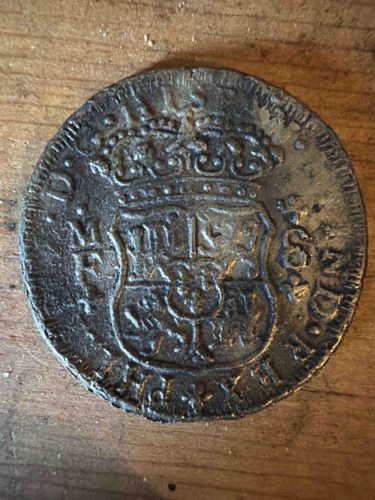
This item is a circular silver-colored coin featuring a prominent crowned coat of arms on the obverse. The arms are flanked by the date '16' and '94', identifying the year of minting as late 17th century. The central shield contains motifs representative of the Dutch Republic era, specifically the provinces or local municipalities of West Friesland or Kampen. Surrounding the crest is a partial Latin inscription that traditionally includes the minting city and the value of '6 ST' (reflecting 6 Stuivers). Physically, the coin shows significant signs of environmental age, including heavy oxidation, surface pitting, and a dark, non-uniform patina that suggests it may have been recovered from soil or an underwater archaeological context. The planchet is somewhat irregular and clipped around the edges, typical of hammered or early screw-press coinage. The strike is moderately sharp in the center but fades toward the legends. Notable wear is seen on the high points of the crown and the inner details of the shield. There is visible porosity across the surface and possible encrustation in the recessed lettering, though the historical integrity remains largely intact. The style is distinctly Baroque Dutch numismatics.
AI-Generated Appraisal Disclaimer
Estimated Value
$40 - $80
Basic Information
Category
Numismatics / Historical Currency
Appraised On
January 30, 2026
Estimated Value
$40 - $80
Item Description
This item is a circular silver-colored coin featuring a prominent crowned coat of arms on the obverse. The arms are flanked by the date '16' and '94', identifying the year of minting as late 17th century. The central shield contains motifs representative of the Dutch Republic era, specifically the provinces or local municipalities of West Friesland or Kampen. Surrounding the crest is a partial Latin inscription that traditionally includes the minting city and the value of '6 ST' (reflecting 6 Stuivers). Physically, the coin shows significant signs of environmental age, including heavy oxidation, surface pitting, and a dark, non-uniform patina that suggests it may have been recovered from soil or an underwater archaeological context. The planchet is somewhat irregular and clipped around the edges, typical of hammered or early screw-press coinage. The strike is moderately sharp in the center but fades toward the legends. Notable wear is seen on the high points of the crown and the inner details of the shield. There is visible porosity across the surface and possible encrustation in the recessed lettering, though the historical integrity remains largely intact. The style is distinctly Baroque Dutch numismatics.
Get Your Items Appraised
Instant estimates of your treasures with AI-powered instant appraisals