AI estimate as of August 31, 2025 · verify with a professional before acting
AI-Generated · Verify before acting
Everything on this page is generated by AI for informational purposes only. AI can make mistakes — the AI may misidentify items or misattribute them (artist, maker, brand, designer, origin, era). This is not an official valuation and should not be used for insurance, sale, tax, estate, legal, or lending purposes — or any decision requiring a certified appraisal. It is not an authoritative claim about any person, brand, or rights holder — do not share or rely on it as a factual statement about a third party. Always consult qualified professionals before making financial decisions.
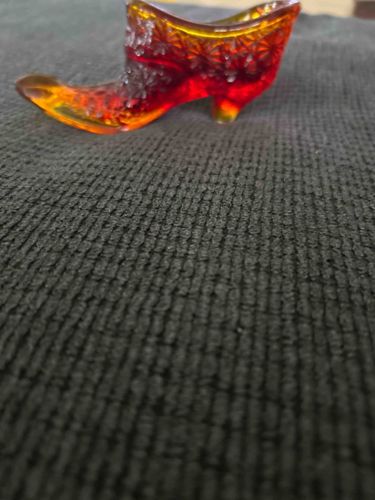
This is a small, decorative glass boot, likely intended as an ornament, toothpick holder, or very small vase. It exhibits a vibrant color gradient, transitioning from a rich, translucent red in the body of the boot to a warmer, amber-yellow hue at the toe and heel. The glass appears to be pressed rather than blown, characterized by a thick, sturdy construction. The surface of the boot is adorned with a molded starburst or hobnail pattern, particularly prominent around the top edge and extending down the sides. This textured detailing catches and refracts light, enhancing its visual appeal. There are no readily apparent cracks, chips, or major structural damage, suggesting good overall condition. The visible surface appears smooth with no significant scratches or signs of excessive wear. The manufacturing method and design suggest it could be a piece of Carnival Glass or a similar type of pressed art glass from the early to mid-20th century, possibly dating from the 1920s to the 1970s. The quality of craftsmanship seems good for pressed glass, with clear details in the molding and no obvious flaws in the glass itself. No maker's marks or signatures are discernible in the provided image.
AI Appraisal Report
Based on my examination of the image provided, this small 'Little Boot' novelty item is a piece of pressed glass, likely Carnival Glass or a type of iridescent art glass, consistent with production from the early to mid-20th century. My visual assessment indicates good overall condition. The vibrant red to amber-yellow color gradient is attractive and characteristic of iridescent finishes. The molded starburst/hobnail pattern is clear and well-defined, suggesting good mold quality and a lack of significant wear. Crucially, I see no readily apparent cracks, chips, or major structural damage. The surface appears smooth, without obvious scratches or excessive wear that would detract from its value.
Market conditions for small, non-descript Carnival Glass novelty items like this are generally moderate. While Carnival Glass has a dedicated collector base, these smaller boot forms are relatively common. Comparables typically sell in the $30-$60 range, depending on color vibrancy, pattern detail, and condition. Demand for these specific 'Little Boots' is stable but not exceptionally high. Rarity is low; many variations of this form were produced by numerous manufacturers.
Factors significantly impacting value include the attractive iridescence and apparent excellent condition. However, the lack of a discernible maker's mark limits its appeal to collectors specializing in specific manufacturers. The primary limitation is, of course, that this is an appraisal based solely on images. I cannot definitively verify authenticity, especially the type of glass (e.g., true Carnival Glass vs. an iridescent modern reproduction), without physical inspection. An in-person examination would allow me to 'ring' the glass for sound, assess its true weight, feel for subtle surface imperfections not visible in photos, and verify the iridescence in varying light sources. Detecting hairline cracks, subtle heat checks, or minuscule fleabites would also require a tactile and magnified inspection. Provenance documentation, if available, would further enhance authenticity verification beyond what visual examination can provide.