These notes were written by the person who submitted this item. Appraiser.AI has not verified them, and the AI's identification and estimate may rely on them.
AI Estimated Value
Not an official valuation
$120-180
AI estimate as of August 21, 2025 · verify with a professional before acting
AI-Generated · Verify before acting
Everything on this page is generated by AI for informational purposes only. AI can make mistakes — the AI may misidentify items or misattribute them (artist, maker, brand, designer, origin, era). This is not an official valuation and should not be used for insurance, sale, tax, estate, legal, or lending purposes — or any decision requiring a certified appraisal. It is not an authoritative claim about any person, brand, or rights holder — do not share or rely on it as a factual statement about a third party. Always consult qualified professionals before making financial decisions.
This analysis also relies on unverified notes provided by the user, which may be incomplete or inaccurate and could affect the result.
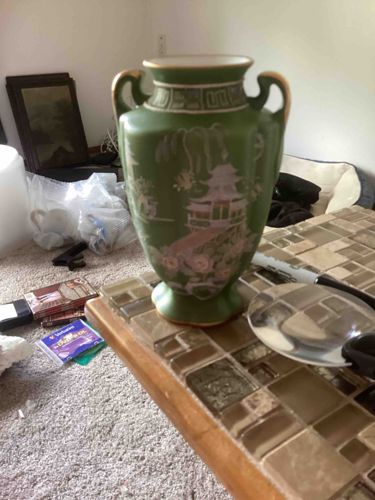
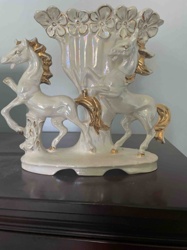
The item is a small to medium-sized urn-shaped vase, approximately 8-12 inches tall, crafted from what appears to be ceramic or porcelain, possibly Noritake china given additional context. Its primary color is a matte, slightly muted olive or moss green, providing a rich background for its intricate hand-painted design. The vase features two prominent handles with a curved, ear-like shape, each adorned with a gold trim along its upper edge and rim, exhibiting some wear or fading on the gold. The neck of the vase is decorated with a repeating geometric or stylized pattern in a lighter, off-white or cream color, possibly with gold accents that are now less prominent. The main body of the vase depicts a scenic oriental motif, typical of Japanese or Chinese landscapes. It includes a prominent multi-tiered pagoda building in shades of light pink, white, and grey, nestled amongst stylized trees and flowing weeping willows in light green and white. In the foreground and on either side of the pagoda, there are clusters of pink flowers, possibly cherry blossoms or peonies, with green foliage. The painting style suggests a delicate, somewhat impressionistic approach. The base of the vase is narrower than the body, circular, and also a matching olive green, with a gold band around its rim. The overall condition appears good, with no obvious cracks or chips visible from the image, though surface dirt or dust is present. The gold accents show some rubbing, indicative of age and handling. The craftsmanship appears to be of good quality, typical of mass-produced decorative ceramics from the early to mid-20th century. While no specific maker's marks are visible, the style is consistent with Noritake's Moriage or Hand-Painted designs that were popular post-WWI.
AI Appraisal Report
I have thoroughly examined the provided images and descriptions of this Noritake-style decorative urn vase. The vase exhibits characteristics consistent with early to mid-20th-century Noritake production, particularly the hand-painted oriental motif and the use of gold accents. The matte olive-green ground, multi-tiered pagoda, and pink floral designs are a common aesthetic for this period. The condition appears good, with no obvious chips or cracks, which is positive. However, the reported wear on the gold trim is expected for an item of this age and indicates handling rather than significant damage. The craftsmanship is typical of mass-produced decorative ceramics from the era, demonstrating good quality without being exceptionally fine art. Market conditions for Noritake decorative pieces vary; simpler items have seen a decline, while more elaborate or rare pieces retain value. This piece, with its detailed motif and good condition, falls into a moderate demand category. It is not exceptionally rare, as similar designs were produced in quantity. Factors impacting value include the strong decorative appeal and good condition, offset by the wear to the gold. Without a clear maker's mark visible in the image, or detailed provenance, full authentication as a genuine Noritake piece cannot be definitively confirmed from images alone. A physical examination would allow me to inspect the base for factory marks, assess the true condition of the gold, and scrutinize the painting quality up close, confirming the authenticity and specific Noritake pattern. Scientific testing is not typically required for this type of ceramic unless fraud is suspected.