AI estimate as of November 9, 2025 · verify with a professional before acting
AI-Generated · Verify before acting
Everything on this page is generated by AI for informational purposes only. AI can make mistakes — the AI may misidentify items or misattribute them (artist, maker, brand, designer, origin, era). This is not an official valuation and should not be used for insurance, sale, tax, estate, legal, or lending purposes — or any decision requiring a certified appraisal. It is not an authoritative claim about any person, brand, or rights holder — do not share or rely on it as a factual statement about a third party. Always consult qualified professionals before making financial decisions.
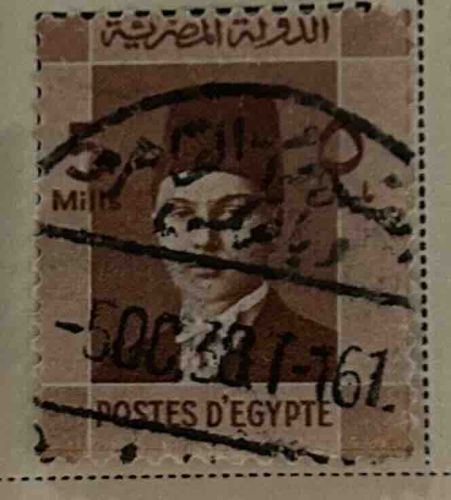
This item is a historical postage stamp from Egypt, featuring a portrait of King Farouk. The stamp is predominantly colored in shades of brown and beige, suggesting an earthy or sepia tone. The portrait of King Farouk is depicted centrally, facing slightly to his left, with details of his face, hair, and collar discernible despite the overprinting. The stamp has distinctive perforated edges, consistent with standard postage stamp manufacturing. At the top, Arabic text is visible, which translates to 'The Egyptian State.' On the left side, the denomination 'Mills' is printed, and on the bottom, 'POSTES D'EGYPTE' is clearly visible, indicating its origin as an Egyptian postal service item. The stamp is heavily postmarked with a black ink cancellation, which obscures a significant portion of King Farouk's face and the surrounding text. The cancellation appears to be a numerical stamp, with '500' and '761' being part of the visible numbers, suggesting it was used a considerable time ago. The condition of the stamp shows clear signs of use and age, including the heavy postmark and what appears to be minor discoloration or patination of the paper. Despite the cancellation, the overall details of the stamp design and its historical context are still evident. The quality of the printing appears fine for its era, indicating a standard level of craftsmanship for philatelic items of this period. The age of the stamp can be estimated to the mid-20th century, given King Farouk's reign from 1936 to 1952. This stamp represents a piece of Egyptian philatelic history from the monarchy era.
AI Appraisal Report
I have examined the provided image of the Egyptian King Farouk 500 Mills Postage Stamp. Based on a visual inspection, the stamp appears authentic, consistent with known issues from King Farouk's reign (1936-1952). The design, denomination, and text ('The Egyptian State', 'Mills', 'POSTES D'EGYPTE') align with philatelic records for this period. The perforated edges and printing quality are typical for stamps of this era.
The condition, however, significantly impacts its value. The stamp bears a heavy black ink cancellation, obscuring a substantial portion of King Farouk's portrait and surrounding text. While cancellation indicates usage, this particular postmark is quite aggressive, reducing the aesthetic appeal and clarity of the design. Minor discoloration or patination is also noted, consistent with age and use. In the philatelic market, heavily cancelled stamps, especially common issues, fetch lower prices.
King Farouk stamps are generally not considered rare, and many examples exist in various conditions. Common issues from this period, even in fine used condition, typically have modest values. The heavy cancellation on this specific example reduces its desirability for collectors who prioritize clear, unobstructed designs or lighter cancellations.
Factors significantly impacting this stamp's value are its heavily cancelled state, which lowers its appeal, and its commonality. While it possesses historical interest, the existing supply likely meets or exceeds demand for heavily used examples. Comparables for heavily cancelled, common King Farouk stamps typically range in the sub-$20 category.
It is important to note that this appraisal is based solely on visual examination of the provided image. Full authentication would ideally require an in-person examination to verify paper type, printing methods, and precise perforation count, as well as to detect any potential alterations or repairs not visible in the photograph. Provenance documentation, though unlikely for a common stamp, would further confirm its history. However, given the item's likely market value, extensive scientific testing would not be economically justified.