These notes were written by the person who submitted this item. Appraiser.AI has not verified them, and the AI's identification and estimate may rely on them.
AI Estimated Value
Not an official valuation
$350 - $600
AI estimate as of July 31, 2025 · verify with a professional before acting
AI-Generated · Verify before acting
Everything on this page is generated by AI for informational purposes only. AI can make mistakes — the AI may misidentify items or misattribute them (artist, maker, brand, designer, origin, era). This is not an official valuation and should not be used for insurance, sale, tax, estate, legal, or lending purposes — or any decision requiring a certified appraisal. It is not an authoritative claim about any person, brand, or rights holder — do not share or rely on it as a factual statement about a third party. Always consult qualified professionals before making financial decisions.
This analysis also relies on unverified notes provided by the user, which may be incomplete or inaccurate and could affect the result.
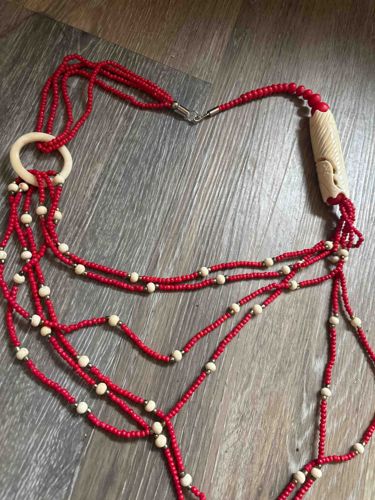
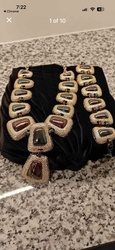
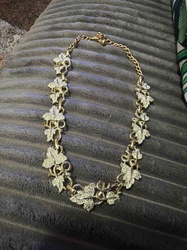
This is a long, multi-strand beaded necklace primarily composed of small, uniformly sized red glass seed beads. The necklace features several distinctive elements that suggest it is an artistic piece rather than a mass-produced item. The main body of the necklace consists of multiple strands of these red beads, interspersed at regular intervals with small, light-colored spherical beads, which appear to be made of a natural material like bone or possibly ivory, given the context of 'Alaskan native art'. Some of these lighter beads are slightly larger than others, creating a subtle visual rhythm. Towards the top, near the clasp, there is a prominent, ring-shaped element crafted from the same light-colored material, likely bone or ivory, which serves as a central anchor for several of the bead strands. This ring shows a smooth, cream-colored surface with a natural patina that suggests age and handling. On the opposite side, towards the back of the neck, is an elongated, tubular bead or pendant, also crafted from the light-colored material. This piece is notably hand-carved with a series of parallel, wavy grooves, giving it a textural, organic, and almost baleen-like appearance. It also exhibits a natural, aged cream to light yellow hue. The carving quality suggests a skilled hand. The necklace is secured with a silver-toned metal hook-and-eye clasp, which appears to be a standard, functional component. There are no immediately visible signs of significant damage beyond potential minor wear consistent with use and age. The general aesthetic, use of natural materials, and hand-carved elements align with indigenous Alaskan native artistry, often incorporating materials like bone, ivory (walrus or mastodon), and shells.
AI Appraisal Report
Upon examining this multi-strand beaded necklace, I am struck by its artistic integrity and alignment with Alaskan Native aesthetics. The piece is primarily composed of vibrant red glass seed beads, contrasted beautifully by light-colored, cream-hued elements stated by the owner to be hand-carved ivory. The condition appears to be very good, with a natural patina on the carved components suggesting age and careful handling. The hand-carved, grooved tubular bead and the smooth ring element are the focal points, exhibiting skilled craftsmanship consistent with indigenous artistic traditions.
The market for authentic Alaskan Native art, especially jewelry incorporating hand-carved ivory or bone, is robust. Similar multi-strand necklaces with verified walrus or mammoth ivory components can range from several hundred to over a thousand dollars, depending on the artist's renown, complexity of the carving, and age. The primary factor influencing this piece's value is the material of the carved elements. Without physical inspection, it is impossible to definitively confirm the material as ivory versus bone, or to identify the type of ivory (e.g., walrus, mammoth). This is a critical distinction, as authenticated ivory significantly increases value.
For full authentication and a more precise valuation, several steps would be required: a physical examination to conduct a hot needle test (on a discreet spot) or observe Schreger lines under magnification to differentiate ivory from bone or synthetic materials. Furthermore, provenance documentation linking the piece to a specific artist or community would substantially elevate its value and collectibility. As it stands, based on the visual evidence of quality craftsmanship and classic design, the piece is a desirable example of its type.