AI estimate as of August 4, 2025 · verify with a professional before acting
AI-Generated · Verify before acting
Everything on this page is generated by AI for informational purposes only. AI can make mistakes — the AI may misidentify items or misattribute them (artist, maker, brand, designer, origin, era). This is not an official valuation and should not be used for insurance, sale, tax, estate, legal, or lending purposes — or any decision requiring a certified appraisal. It is not an authoritative claim about any person, brand, or rights holder — do not share or rely on it as a factual statement about a third party. Always consult qualified professionals before making financial decisions.
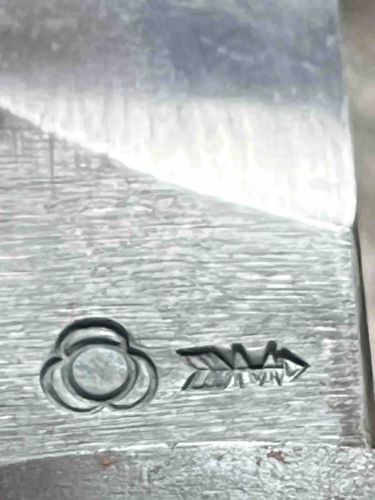
The item appears to be a piece of metal, likely silver or silver-plated, judging by its reflective, somewhat tarnished surface and the typical appearance of hallmark stamps. The surface exhibits a brushed or textured finish, possibly from manufacturing or wear, which shows horizontal striations across the visible area. Two distinct impressed marks are clearly visible. On the left, there is a circular or six-lobed rosette-like symbol, which could represent a specific region or standard mark. To its right, a stylized arrow or feathered arrow symbol is present, which is commonly associated with the Gorham Manufacturing Company, a prominent American silversmith. The crispness of these marks suggests they are original manufacturer’s stamps, possibly hallmarks indicating the purity of the metal or a manufacturer's mark. The background metal shows signs of age and handling, including minor scratches and possibly areas of oxidation or patina, indicated by faint darker specks. Without further context or a view of the entire object, it's difficult to ascertain its exact use, but the presence of these particular marks strongly points to it being from a piece of Gormah silverware, dating likely from the late 19th to mid-20th century, a period when such marks were prevalent. The quality of the impression of the marks is good, indicating precise manufacturing processes.
AI Appraisal Report
Based on my visual examination of the provided image, the item appears to be a section of a silver or silver-plated object, distinguished by two clear impressed marks: a rosette-like symbol and a stylized arrow. The arrow mark is consistent with those used by the Gorham Manufacturing Company, a renowned American silversmith. The crispness of these marks suggests authenticity, characteristic of manufacturer's stamps. The surface shows a brushed finish and signs of age, including minor scratches and possible patina, indicating typical wear for an object from the late 19th to mid-20th century.
Given that only a portion of the object and its marks are visible, and the overall form and function are unknown, determining a precise value is challenging. The value of Gorham silver depends heavily on the specific item (e.g., flatware, hollowware, decorative piece), its pattern, completeness, and overall condition. Without this information, I cannot fully assess market conditions or comparables. However, Gorham pieces, especially solid silver, generally command good demand. Rarity is also dependent on the specific pattern and production numbers.
Factors significantly impacting value here are the unknown metal composition (silver vs. silver-plate) and the identity of the full object. If it's solid sterling silver and part of a desirable, complete set or a unique piece, its value would be significantly higher. If it's silver-plated or a common, incomplete fragment, the value is nominal, primarily for its scrap metal content or as an identification example.
My primary limitation in authenticity verification from this image alone is the lack of physical examination. An in-person inspection would allow me to perform a silver acid test to confirm metal composition, measure the object, assess its complete form, and verify the weight for a more accurate valuation. Provenance documentation, if available, would also greatly assist in confirming its history and authenticity. Without the full object, this appraisal is speculative regarding its market value beyond a very minimal assumed baseline for a Gorham mark.