AI estimate as of August 1, 2025 · verify with a professional before acting
AI-Generated · Verify before acting
Everything on this page is generated by AI for informational purposes only. AI can make mistakes — the AI may misidentify items or misattribute them (artist, maker, brand, designer, origin, era). This is not an official valuation and should not be used for insurance, sale, tax, estate, legal, or lending purposes — or any decision requiring a certified appraisal. It is not an authoritative claim about any person, brand, or rights holder — do not share or rely on it as a factual statement about a third party. Always consult qualified professionals before making financial decisions.
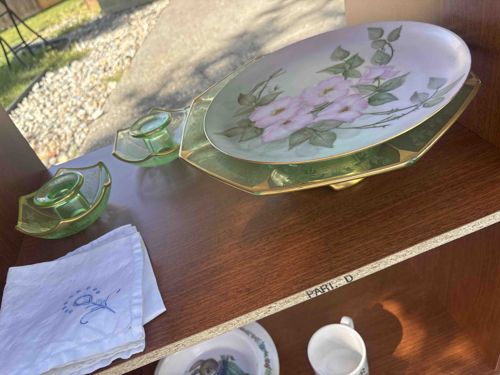
The item prominently featured is a decorative porcelain or ceramic plate, likely hand-painted, displaying a cluster of pink wild roses with their associated green leaves and thorny stems. The background of the painting transitions from a lighter, almost white or very pale green at the top to a deeper, more saturated green towards the bottom, suggesting a naturalistic landscape or gradient. The plate itself is oval-shaped, with a gently scalloped or undulating rim. It appears to rest on a deeper, hexagonal or octagonal dish or bowl which is a translucent, possibly uranium or depression-era green glass, with a distinct gold-colored rim or base. This suggests the plate might be part of a larger serving set or a display piece intended to be paired with other decorative elements. The gold accent appears to be a metallic paint or gilting. The overall condition of the plate and the underlying green glass piece appears good, with no immediately visible chips, cracks, or significant wear to the painted surface, indicating good preservation. This vibrant floral motif, often seen in late 19th to early 20th-century decorative arts, hints at an Edwardian or Art Nouveau influence, emphasizing natural forms. The craftsmanship of the painting suggests a skilled hand, with delicate brushwork and subtle shading that gives the roses depth. No discernible maker's marks or signatures are visible in the provided image.
AI Appraisal Report
I have examined the image provided of the Hand-Painted Wild Rose Ceramic Plate on Green Glass Dish. From a visual standpoint, the set appears to be in very good condition, showing no obvious chips, cracks, or significant paint loss on the hand-painted porcelain plate. The green glass dish also seems intact, and the gold accent retains its luster. The floral motif strongly suggests a late 19th to early 20th-century origin, aligning with Edwardian or Art Nouveau aesthetics, typical of 'cabinets of curiosities' items or decorative pieces of that era. The hand-painted detail on the plate indicates a skilled artisan, adding to its artistic merit.
Market conditions for such decorative antique sets can vary. Comparable items, often found in estate sales or online antique markets, can range widely based on provenance, artist signature (which is absent here), and overall condition. Items of this nature, especially without definitive maker's marks or artist signatures, often fall into a mid-range collecting category. While attractive, their rarity is moderate; similar hand-painted pieces from that period are not uncommon. The pairing with the green glass dish enhances its display value and perceived completeness.
Factors significantly impacting value include the lack of a discernible maker's mark or artist signature, which hinders precise attribution and can limit value growth. The specific type of green glass (e.g., uranium glass) could slightly increase its appeal to niche collectors, but this cannot be confirmed from the image alone. The primary value lies in its decorative appeal, condition, and age.
It is important to note the limitations of this appraisal, as it is based solely on visual examination of an image. Authenticity cannot be definitively verified without physical inspection. An in-person examination would allow for tactile assessment of materials, examination of the underside for any hidden marks or repairs, and closer inspection of the painting technique and the glass type. Provenance documentation, if available, would significantly enhance authenticity and value. Scientific testing for material composition (e.g., lead in glaze, specific type of glass) is beyond the scope of a visual appraisal and would require specialized equipment.