AI Appraisal Estimate

AI-generated estimates · not official valuations

From the user

What was submitted

Photo and notes provided by the user — not generated by AI

Submitted item photo
Submitted photo · June 22, 2026

User's notes

No additional notes provided.

AI analysis below

AI appraisal

AI analysis & estimate

AI-Generated · Verify before acting

Everything below is generated by AI for informational purposes only. AI can make mistakes — the AI may misidentify items or misattribute them (artist, maker, brand, designer, origin, era). This is not an official valuation and should not be used for insurance, sale, tax, estate, legal, or lending purposes — or any decision requiring a certified appraisal. It is not an authoritative claim about any person, brand, or rights holder — do not share or rely on it as a factual statement about a third party. Always consult qualified professionals before making financial decisions.

Read the full disclaimer

AI Identification

·Not independently authenticated·Verify before acting

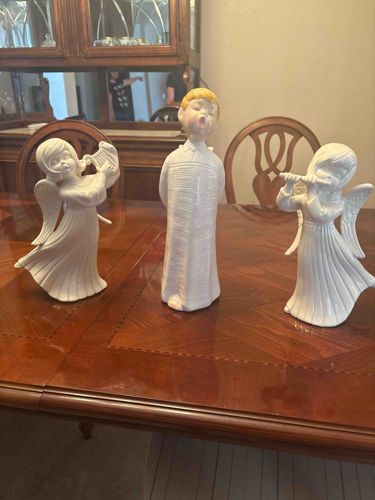
Vintage Goebel Hummel White Bisque Musical Trio: Angel with Harp, Choir Boy, and Angel with Flute

Collectibles / Decorative Ceramics

AI Estimated Value

·Not an official valuation·Verify before acting

$45-75

As of June 22, 2026

AI Item Analysis

·AI can make mistakes·Verify before acting
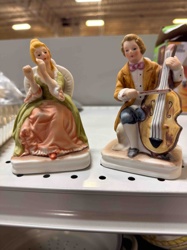
This set features three vintage porcelain figurines likely produced by Goebel (Hummel) in their signature white bisque or blanc de chine finish. The collection includes a center choir boy singing with his head tilted back, flanked by two side-facing angels—one playing a harp and the other a flute. Each figure stands approximately 6 to 8 inches tall and is crafted from high-quality glazed ceramic or porcelain. The figures exhibit a monochrome white aesthetic, with the notable exception of the choir boy's hair, which features a subtle yellow/blonde tint. The construction is characterized by flowing, pleated robes and textured surfaces that give the garments a fabric-like appearance. The craftsmanship shows soft, rounded facial features typical of Mid-Century Goebel designs. There are no immediate visible signs of major cracks or repairs, though such items are prone to 'crazing' in the glaze over time. While maker's marks are not visible in this photo, they would typically be found stamped in blue or incised on the underside of the base. These figures likely date from the 1960s to 1980s, representing a classic example of German porcelain artistry often used for holiday or religious decor.
AI Appraisal Report

·AI can make mistakes·Verify before acting
I have virtually examined this three-piece Goebel Hummel porcelain ensemble, consisting of two musical angels and one choir boy. These pieces are characteristic of the 'White Bisque' or 'Blanc de Chine' style produced by Goebel in the mid-to-late 20th century. The figures exhibit the soft, rounded modeling typical of Sister Maria Innocentia Hummel’s designs. Based on the visual inspection, the surfaces appear clean with no evidence of structural restoration or significant 'flea bites' on the delicate edges of the robes or instruments. The subtle yellow tinting on the choir boy's hair is a common variations in these monochromatic series. The market for 20th-century German ceramics has significantly cooled since its peak in the late 1990s. While Goebel items remain staples for collectors, the white bisque variants are generally less sought after than the traditional hand-painted figurines, unless they are the larger, more complex editions. These pieces appear to be the standard 6-to-8-inch production, which are relatively common in the secondary market. Current demand is primarily driven by seasonal holiday decorators rather than high-end rarities. Limitation on Authenticity: This appraisal is based solely on digital images. A definitive valuation requires a physical inspection to confirm the 'TMK' (Trademark) mark on the underside, which determines the exact era of production (e.g., TMK-3 vs. TMK-6). Furthermore, I cannot verify the presence of 'crazing' (microscopic cracks in the glaze) or internal structural integrity without tactile examination. Full authentication would require verifying the incised 'M.I. Hummel' signature on each base and checking for any professionally disguised repairs using ultraviolet light.

Get your items appraised

Instant estimates of your treasures with AI-powered appraisals

Browse More Appraisals