AI estimate as of September 20, 2025 · verify with a professional before acting
AI-Generated · Verify before acting
Everything on this page is generated by AI for informational purposes only. AI can make mistakes — the AI may misidentify items or misattribute them (artist, maker, brand, designer, origin, era). This is not an official valuation and should not be used for insurance, sale, tax, estate, legal, or lending purposes — or any decision requiring a certified appraisal. It is not an authoritative claim about any person, brand, or rights holder — do not share or rely on it as a factual statement about a third party. Always consult qualified professionals before making financial decisions.
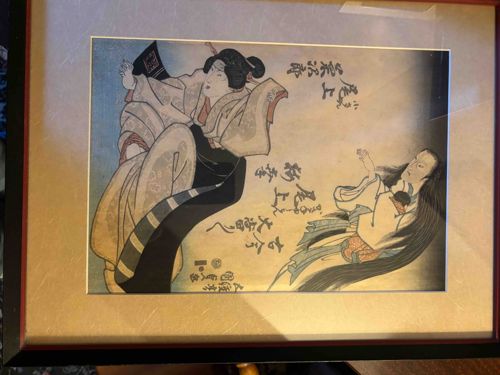
This item is a framed Japanese Ukiyo-e woodblock print depicting two figures, likely from a narrative or theatrical scene. The print features a dynamic composition with a central female figure in an elaborate kimono gesturing with a fan, appearing to confront or interact with a male figure who seems to be falling or floating, characterized by long, dark, flowing hair and a distinct facial expression. The color palette primarily includes muted blues, tans, whites, and blacks for the garments, set against a lighter background that transitions from a pale blueish tone on the left to a darker, almost sepia or faded brown on the right. Calligraphy, presumably Japanese text, is visible in various clusters across the print, adding to its authentic Japanese aesthetic and possibly providing contextual information, title, or artist's signature. The print itself appears to be matted within a beige or gold-toned matboard, which may have some subtle texture or marbling. This matboard is framed within a dark, possibly black or dark wood frame, featuring a subtle red inner lip or accent that adds a touch of contrast and refinement. The print shows signs of age, with some slight fading of colors consistent with vintage paper and inks. There are no major tears or creases visible through the glass, suggesting it has been preserved reasonably well within the frame. The overall impression is one of an older, perhaps Meiji or Edo period, print due to the style of illustration and artistic conventions; however, without clearer access to signatures or specific publishing marks, a definitive age is difficult to ascertain from the image alone. The craftsmanship of the print itself, showcasing fine lines and detailed patterns on the kimonos, indicates a level of quality typical of traditional Japanese woodblock art.
AI Appraisal Report
Based on my visual examination of the provided image, this framed Japanese Ukiyo-e woodblock print appears to be a genuine article, likely dating from the Edo or Meiji period, judging by the stylistic elements, artistic conventions, and the visible aging of the paper and inks. The fine lines, detailed patterns on the kimonos, and the dynamic composition are characteristic of traditional Ukiyo-e craftsmanship. The print's condition is good for its age; while some fading is evident, which is common for vintage inks and paper, there are no visible major tears or creases, suggesting it has been reasonably well-preserved within its frame. The framing itself, with a beige/gold-toned mat and a dark frame with a subtle red inner lip, is appropriate for such a piece and offers decent protection.
Market conditions for Ukiyo-e prints remain steady, with demand for well-preserved and aesthetically pleasing examples. However, specific artist attribution and series identification significantly impact value. Without clear access to signatures, seals, or publisher marks—which cannot be definitively identified from the image alone—it is challenging to pinpoint its exact provenance or rarity. The presence of calligraphy suggests contextual information that could, upon translation, reveal more about its origin or specific scene depicted, potentially enhancing its value.
To provide a full authentication and more precise valuation, an in-person examination is crucial. This would allow for a detailed inspection of the paper quality, printing process (e.g., specific woodgrain impressions), presence of back-stamps or watermarks, and positive identification of any artist's signatures or publisher's seals. Furthermore, expert translation of the calligraphy would be vital. Without this, I am valuing it as a decorative, good-condition, unsigned/unattributed Ukiyo-e print from a desirable period.