AI estimate as of August 10, 2025 · verify with a professional before acting
AI-Generated · Verify before acting
Everything on this page is generated by AI for informational purposes only. AI can make mistakes — the AI may misidentify items or misattribute them (artist, maker, brand, designer, origin, era). This is not an official valuation and should not be used for insurance, sale, tax, estate, legal, or lending purposes — or any decision requiring a certified appraisal. It is not an authoritative claim about any person, brand, or rights holder — do not share or rely on it as a factual statement about a third party. Always consult qualified professionals before making financial decisions.
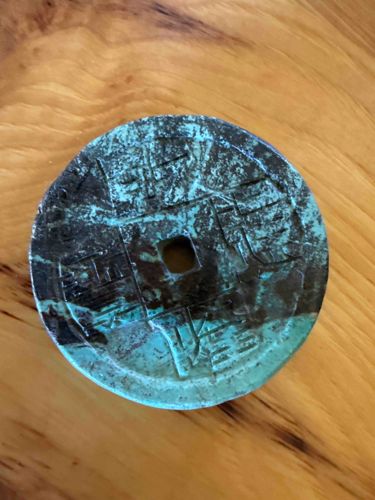
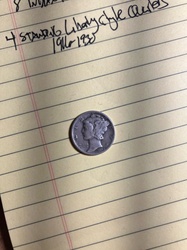
The item is a circular, flat coin or charm, likely made from a copper alloy such as bronze or brass, given the prominent turquoise-green patination (verdigris) visible across its surfaces. Its color varies significantly, encompassing dark brown/black where the original metal surface may be more exposed or less corroded, transitioning to a vivid teal and lighter blue-green in areas with heavy mineral deposits due to oxidation. The coin features a square hole in its center, a common characteristic of ancient East Asian coinage, particularly Chinese cash coins. The front face displays four distinct ideograms, or characters, arranged symmetrically around the central square hole. While the exact characters are somewhat obscured by the heavy patina and surface pitting, they are typical of inscriptions found on ancient Chinese coinage. The surface texture is rough and pitted, indicating significant age, environmental exposure, and likely a long period of burial or submersion. There are no readily discernible manufacturing marks or clear signatures, which is common for this type of ancient currency. The edges appear somewhat irregular and worn. The overall condition suggests a significant amount of wear and oxidation, demonstrating its antiquity and history. The craftsmanship appears to be cast, rather than struck, which was typical for Chinese cash coins. This piece likely dates from an ancient or medieval period, possibly from one of China's imperial dynasties, and due to its substantial patination, it could be several centuries, if not over a millennium, old. The quality indicators point towards a utilitarian object rather than a finely detailed artistic piece, with its value more intrinsically linked to its historical context and metal content rather than intricate design details.
AI Appraisal Report
Based on my visual examination of the provided image, this appears to be an ancient Chinese cash coin, characterized by its circular shape and central square hole. The prominent turquoise-green patination, indicative of copper alloy oxidation (verdigris), along with the rough, pitted surface texture, strongly suggests significant age and environmental exposure. The casting method is consistent with ancient Chinese numismatic practices. The four ideograms around the central hole are typical for this type of coinage, though their exact identification is difficult due to the heavy patina.
In terms of condition, I would rate it as 'Poor' to 'Fair' given the extensive corrosion and wear. Authenticity, based solely on this image, seems plausible as it exhibits characteristics consistent with genuine period pieces. However, without in-hand inspection, definitive authentication is challenging. Many reproductions exist, and details like casting seams, metal composition, and precise character forms are crucial. Market conditions for ancient Chinese cash coins are generally stable, but value varies dramatically based on rarity, condition, specific dynasty, and emperor. This particular example, while clearly ancient, lacks the exceptional detail or rarity that would command a higher price. Demand exists primarily among collectors of ancient world coinage and Chinese artifacts. The principal factors impacting its value are its poor state of preservation, which obscures defining characteristics, and the common nature of general cash coins.
For full authentication and a more precise valuation, a physical examination would be essential to assess weight, diameter, the precise nature of the metal (e.g., through XRF analysis), and a clearer reading of the characters. This would allow for comparison with known genuine examples and help rule out modern counterfeits or later reproductions. Provenance documentation, if available, would also significantly enhance its value and confirm its historical journey.