AI Appraisal Estimate

AI-generated estimates · not official valuations

From the user

What was submitted

Photo and notes provided by the user — not generated by AI

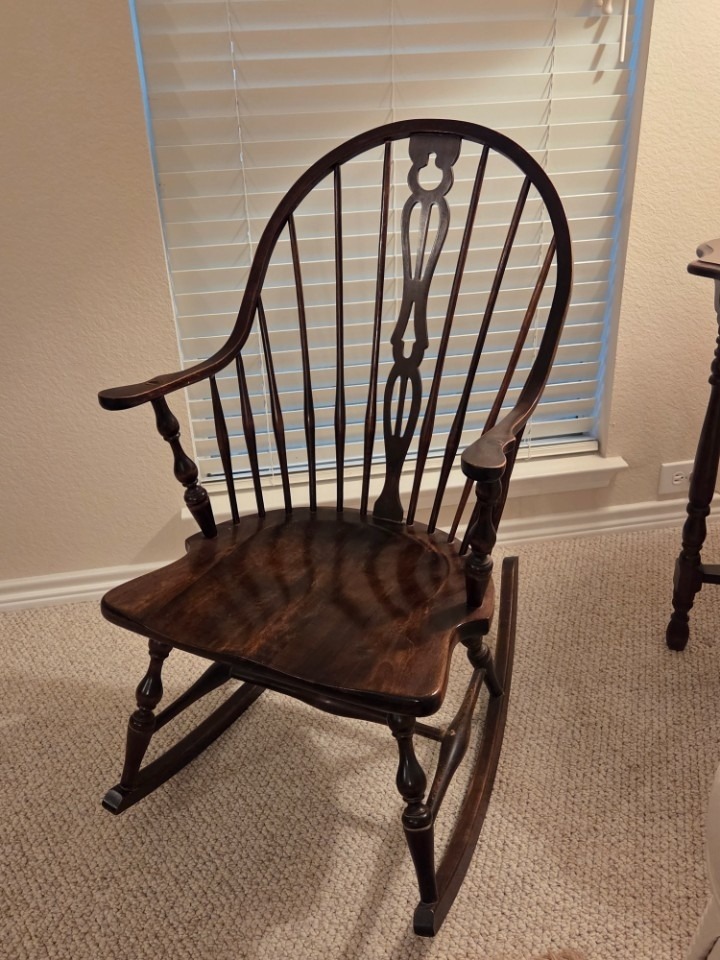
Submitted item photo
Submitted photo · June 8, 2026

User's notes

No additional notes provided.

AI analysis below

AI appraisal

AI analysis & estimate

AI-Generated · Verify before acting

Everything below is generated by AI for informational purposes only. AI can make mistakes — the AI may misidentify items or misattribute them (artist, maker, brand, designer, origin, era). This is not an official valuation and should not be used for insurance, sale, tax, estate, legal, or lending purposes — or any decision requiring a certified appraisal. It is not an authoritative claim about any person, brand, or rights holder — do not share or rely on it as a factual statement about a third party. Always consult qualified professionals before making financial decisions.

Read the full disclaimer

AI Identification

·Not independently authenticated·Verify before acting

Bow-Back Sack-Back Windsor Rocking Chair

Furniture - Seating

AI Estimated Value

·Not an official valuation·Verify before acting

$450 - $650

As of June 8, 2026

AI Item Analysis

·AI can make mistakes·Verify before acting
This is a reproduction-style Windsor rocking chair, specifically a sack-back or bow-back variant, crafted likely in the mid-to-late 20th century. The chair features a high, steam-bent continuous hoop back that transitions into curved armrests supported by turned spindles and a central pierced decorative splat. The splat showcases a classic 'fiddle' or 'wheel' style cutout, typical of colonial revival aesthetics. The seat is formed from a thick, solid wood plank—likely elm, oak, or cherry—with deep 'saddle' carving for ergonomic comfort, showing a rich, variegated dark brown grain under a glossy finish. The substructure consists of four stout, baluster-turned legs joined to the runners with a box stretcher for stability. The finish is a dark chestnut or mahogany-toned stain that exhibits some light surface wear, particularly on the armrests and the leading edge of the rockers, suggesting moderate domestic use. No definitive maker's mark is visible from this angle, though the uniform turning and finish suggest a high-quality commercial production rather than a 18th-century primitive hand-built piece. The craftsmanship is evidenced by the tight joinery and symmetrical spindle placement, reflecting a Traditional American or Colonial Revival style.

AI Appraisal Report

·AI can make mistakes·Verify before acting
I have completed a visual examination of this Windsor sack-back rocking chair. The piece is a well-executed mid-to-late 20th-century reproduction in the Colonial Revival style. My assessment of the construction—specifically the uniform baluster turnings, the high-gloss finish, and the presence of a pierced decorative splat—indicates this is a commercial production rather than an 18th-century antique. The condition is excellent, showing minor surface abrasions on the rockers and armrests consistent with domestic use, which does not significantly detract from its value. The market for reproduction Windsor furniture remains stable, particularly for pieces with deep saddle carving and robust joinery. This chair sits at the higher end of the secondary market for 'used' quality furniture due to its classic silhouette and functional appeal. However, the lack of a prominent maker’s mark (such as Nichols & Stone or a bespoke craftsman) prevents a higher valuation. Rarity is low, as these were produced in volume during the Americana revival peak. As this appraisal is based on photographic evidence, it is subject to limitations. I cannot verify the specific wood species, the presence of hidden repairs, or the integrity of the leg-to-runner joints. A full authentication would require an in-person inspection to examine the underside for maker’s stamps or labels and to confirm that the joinery is wedged rather than glued with modern synthetics. No scientific testing is required, as the style and wear are consistent with a late-modern origin.

Get your items appraised

Instant estimates of your treasures with AI-powered appraisals

Browse More Appraisals