AI estimate as of October 18, 2025 · verify with a professional before acting
AI-Generated · Verify before acting
Everything on this page is generated by AI for informational purposes only. AI can make mistakes — the AI may misidentify items or misattribute them (artist, maker, brand, designer, origin, era). This is not an official valuation and should not be used for insurance, sale, tax, estate, legal, or lending purposes — or any decision requiring a certified appraisal. It is not an authoritative claim about any person, brand, or rights holder — do not share or rely on it as a factual statement about a third party. Always consult qualified professionals before making financial decisions.
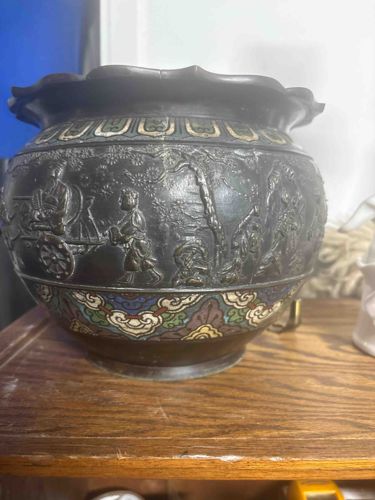
This appears to be a Japanese bronze planter or brazier, likely from the Meiji period (1868-1912) or early 20th century, characterized by its intricate craftsmanship and mixed-media construction. The item features a robust, rounded body with a flared, scalloped rim. The primary material seems to be bronze, which has developed a dark, rich patina over time, suggesting age and exposure. The central band of the vessel is adorned with elaborate high-relief scenes depicting figures, possibly in a landscape or narrative setting, including a person in a cart or rickshaw-like vehicle being pulled by another figure, surrounded by trees and architectural elements. The details in the bronze work are fine, indicating a high level of skill in casting and chasing. Beneath this bronze relief band, there is a prominent section of cloisonné enamel work. This band displays a pattern of stylized clouds or ruyi motifs in vibrant colors, including blues, greens, reds, yellows, and browns, outlined in what appears to be thin metal wires (cloisons). This colorful enamel work provides a striking contrast to the darker bronze. Above the main relief, just below the rim, there's another decorative band with repetitive, abstract patterns, possibly stylized lotus petals or arches, accented with lighter greenish-grey and subtle gold tones. The item’s overall condition shows evidence of age-appropriate wear, including minor abrasions and inconsistencies in the patina, particularly on raised areas. The cloisonné appears largely intact, though closer inspection would be needed to identify any subtle cracks or losses in the enamel. The construction suggests a substantial and heavy piece, indicative of quality craftsmanship. The combination of bronze relief and cloisonné enamel is a hallmark of decorative arts from this period, particularly in Japan, where such skill was highly valued.
AI Appraisal Report
I have examined the provided image of what appears to be a Japanese bronze and cloisonné planter or brazier. Based on its style, intricate mixed-media construction, and the dark, rich patina developed on the bronze, I assess this piece to be a genuine artifact, likely originating from the Meiji period (1868-1912) or very early 20th century. The high-relief bronze work depicting figures in a narrative setting showcases exceptional casting and chasing skills, characteristic of the era's finest metalwork. The integration of a vibrant cloisonné enamel band below, with its stylized cloud or ruyi motifs in multiple colors, further enhances its artistic merit and craftsmanship. The contrast between the dark bronze and the colorful enamel is striking.
The overall condition appears good for an item of its age, exhibiting age-appropriate wear such as minor abrasions and inconsistencies in the patina, particularly on raised areas. The cloisonné enamel seems largely intact; however, without a physical inspection, precise assessment of any hairline cracks, subtle losses, or over-restorations in the enamel is impossible. The combination of bronze and cloisonné was popular during the Meiji period, and well-executed examples are consistently sought after by collectors.
Market conditions for high-quality Meiji-era decorative arts remain robust, especially for pieces demonstrating fine craftsmanship and unique aesthetic appeal. Comparables of similar bronze and cloisonné works from this period have achieved values within this range, particularly those with intricate figurative bronze work. The demand for such items is steady, and their relative rarity, particularly of pieces in good condition with complex designs, contributes positively to their value. Its substantial weight, implied by the construction, also suggests quality.
To fully authenticate and assess the condition, an in-person examination would be crucial. This would allow me to accurately determine the extent of any enamel damage, assess the bronze quality in detail, identify possible repairs or restorations, and inspect any maker's marks or signatures that might be present. Provenance documentation, if available, would also significantly aid in confirming its authenticity and history, potentially increasing its market value.