AI estimate as of October 1, 2025 · verify with a professional before acting
AI-Generated · Verify before acting
Everything on this page is generated by AI for informational purposes only. AI can make mistakes — the AI may misidentify items or misattribute them (artist, maker, brand, designer, origin, era). This is not an official valuation and should not be used for insurance, sale, tax, estate, legal, or lending purposes — or any decision requiring a certified appraisal. It is not an authoritative claim about any person, brand, or rights holder — do not share or rely on it as a factual statement about a third party. Always consult qualified professionals before making financial decisions.
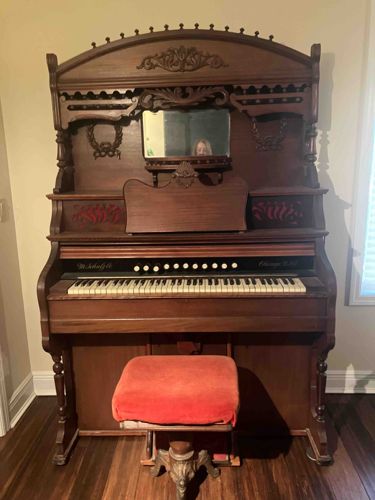
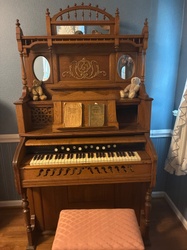
This item is an antique reed organ, likely manufactured by W. W. Kimball of Chicago, as indicated by the legible 'W. W. Kimball Co.' and 'Chicago, U.S.A.' markings above the keyboard. The organ features a dark, rich wood finish, possibly walnut or mahogany, with prominent Victorian-era aesthetics. Its physical characteristics include a tall, ornate superstructure with carved embellishments, including a central shell-like motif, scrolled accents, and decorative rosettes. A small, rectangular mirror is set into the upper frame, flanked by two carved wreath designs. The top edge of the organ's backboard is adorned with a series of small finials. Below the mirror, there is a music stand, also in matching wood. The keyboard consists of a standard arrangement of white and black keys, suggesting a typical piano-style layout. Above the keyboard, to the right, are a row of approximately ten white stop knobs, indicating various tonal registers. The front of the organ below the keyboard features decorative red-painted or inlaid panels with intricate scrollwork, adding a pop of color to the otherwise monochromatic wood. The organ's base is substantial, supported by four turned and carved legs, giving it a sturdy appearance. A notable condition issue visible is the presence of dust and grime, particularly on the lower sections and within the carved crevices. The wood finish appears generally well-preserved for its age, though minor surface wear or scratches may be present consistent with an antique item. The white keys show some discoloration, likely from age and use. Accompanying the organ is a matching upholstered stool with a red velvet or velour cushion, which appears worn and slightly flattened from use. The stool base is made of ornately carved metal, possibly cast iron, with decorative elements on its feet. The overall style points to a late 19th or early 20th-century manufacturing period, consistent with the Victorian or Edwardian eras. The craftsmanship exhibits detailed woodworking and decorative artistry typical of high-quality musical instruments of its time. The specific ornate carvings and general design suggest a parlor or home instrument, intended to be both visually striking and musically functional.
AI Appraisal Report
I have examined the provided image of this Antique W. W. Kimball Chicago Reed Organ with Stool. Based on the legible markings and characteristic design, I confirm its likely origin from W. W. Kimball of Chicago, consistent with a late 19th or early 20th-century manufacturing period. The organ features a dark wood finish, likely walnut or mahogany, with significant Victorian-era adornments including carved embellishments, a mirror, and decorative finials. The accompanying stool with its red velvet cushion and ornate metal base enhances the overall presentation. The white keys show expected discoloration for an item of this age. A notable condition issue is the visible dust and grime, which suggests a lack of recent maintenance but doesn't necessarily indicate severe damage. The wood finish appears generally well-preserved, though minor surface wear is to be expected. While visually appealing, reed organs, even fine examples like this Kimball, typically do not command high prices in today's market. Their large size, weight, and the specialized maintenance required (bellows, reeds) make them less desirable for many modern collectors or homeowners compared to smaller, more versatile instruments. Comparables often sell in the low to mid-hundreds at auction or online marketplaces, particularly if they are not in perfect playing condition. The decorative aesthetic appeals to a niche market for period furniture or musical instrument collectors. Factors impacting value include the dusty condition, which suggests it may not be in playing order, and the worn stool cushion. Rarity is moderate; while a high-quality instrument, Kimball produced many organs. To fully authenticate its originality and confirm any internal issues, an in-person examination, including opening the back for inspection of the reeds, bellows, and internal mechanisms, is crucial. Without this, I cannot definitively confirm playing condition or the absence of internal damage, which significantly affects value.