AI estimate as of August 15, 2025 · verify with a professional before acting
AI-Generated · Verify before acting
Everything on this page is generated by AI for informational purposes only. AI can make mistakes — the AI may misidentify items or misattribute them (artist, maker, brand, designer, origin, era). This is not an official valuation and should not be used for insurance, sale, tax, estate, legal, or lending purposes — or any decision requiring a certified appraisal. It is not an authoritative claim about any person, brand, or rights holder — do not share or rely on it as a factual statement about a third party. Always consult qualified professionals before making financial decisions.
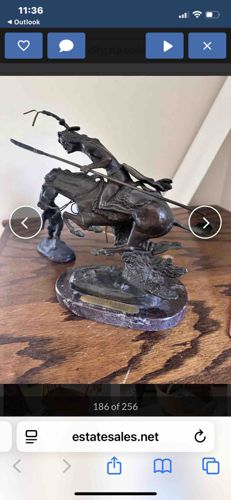
This item is a bronze sculpture depicting a Native American figure on horseback, poised as if in motion or during a hunt/battle. The primary figure, a rider, is depicted with a spear or a similar long weapon held outwards, and what appears to be a quiver of arrows visible on the rider's back/side. The horse is captured mid-stride, contributing to the dynamic feel of the piece. To the left and slightly behind the main equestrian group, there is a smaller, separate figure, possibly a companion or a secondary element of the scene, though its details are less discernible. The entire composition is mounted on a base that looks like polished stone, possibly marble or granite, with visible purple-grey veining. There is a small rectangular plaque or nameplate affixed to the front of this base, likely containing the title of the piece, artist's name, or edition number, though its text is not legible in the provided image. The bronze itself has a dark, rich patina, suggesting age and traditional bronze casting techniques. There are no obvious signs of significant damage like breaks or repairs, but the patina appears consistent with natural aging. The craftsmanship appears to be of good quality, with detailed rendering of the figures' musculature, clothing, and the horse's mane and tail, indicating a skilled sculptor. The overall style suggests a realist or academic approach to sculpture, common in late 19th to mid-20th century Western art, particularly works depicting American historical or frontier themes. The base shows some minor scuffs or wear expected from handling and display over time. The size appears to be substantial, likely a table-top or mantelpiece sculpture rather than a miniature.
AI Appraisal Report
Based on my visual examination of the provided image, this Native American Equestrian Bronze Sculpture appears to be a robust and finely detailed piece. The dark patina suggests traditional bronze casting methods and reasonable age, consistent with natural aging. I observe no obvious damage such as breaks or repairs, and the minor scuffs on the polished stone base are typical of handling and display over time. The craftsmanship, particularly in the rendering of musculature and dynamic posture, indicates a skilled sculptor. The style aligns with realist or academic approaches popular during the late 19th to mid-20th century for frontier themes.
Market conditions for historical American bronze sculptures, especially those depicting Native American subjects, remain stable with consistent demand for well-executed pieces. Comparables typically include works by artists like Frederic Remington, Charles M. Russell, or their contemporaries focused on Western Americana. While the individual identity of the artist and the specific title are not discernible from the image, clarity on these points would significantly impact value. The presence of the smaller, secondary figure adds narrative depth, enhancing its artistic merit.
Without physical inspection, I cannot confirm the authenticity definitively; for example, distinguishing an original, period casting from a later recasting or reproduction is impossible from images alone. A thorough in-person examination would allow for tactile inspection of patina, casting marks, and weight, while provenance documentation (e.g., bills of sale, exhibition history) would provide crucial validation. Scientific testing of the metal composition could further confirm age. The legibility of the plaque text would also be vital.