AI estimate as of November 2, 2025 · verify with a professional before acting
AI-Generated · Verify before acting
Everything on this page is generated by AI for informational purposes only. AI can make mistakes — the AI may misidentify items or misattribute them (artist, maker, brand, designer, origin, era). This is not an official valuation and should not be used for insurance, sale, tax, estate, legal, or lending purposes — or any decision requiring a certified appraisal. It is not an authoritative claim about any person, brand, or rights holder — do not share or rely on it as a factual statement about a third party. Always consult qualified professionals before making financial decisions.
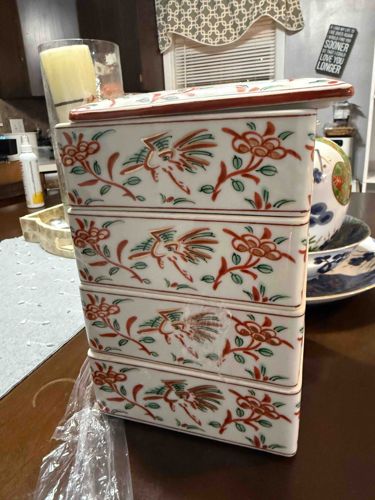
This item is a Japanese Imari-style stacking porcelain container, likely functioning as a 'hosodana' (a type of display shelf or cabinet for small items) or a multi-tiered food box (jubako). It comprises at least five individual rectangular tiers, including a lid. The primary material is porcelain, distinguished by its bright white ground. The decoration is applied in an overglaze enamel palette characteristic of Imari ware, featuring vibrant iron red, evergreen, and possibly some gold or brown accents, although the latter appears mostly as a muted brown. Each tier is adorned with a repeating pattern of stylized phoenix-like birds (Hō-ō) in flight, interspersed with floral motifs that resemble peonies or chrysanthemum blossoms, all connected by delicate scrolling vines and foliage. A thin red band outlines the top and bottom edges of each tier, enhancing the visual separation and stacking design. The quality of the hand-painted decoration appears consistent across all visible tiers, suggesting skilled craftsmanship. The overall condition appears excellent from the visible angles, with no obvious chips, cracks, or significant wear to the enamel. The edges appear crisp and the glaze bright. There is a faint discoloration or possible minor scratch on one of the birds on the third tier from the top, but it does not appear to be a major flaw. Given the traditional design and decorative style, this item likely dates from the late 19th century to the mid-20th century, consistent with the resurgence and continued production of Imari-style porcelain for domestic use and export. The construction is precise, allowing for neat stacking of the individual elements, a testament to its functional design. The item exhibits a classic aesthetic appeal, typical of Japanese porcelain artistry.
AI Appraisal Report
I have examined the provided image of this Japanese Imari-style stacking porcelain hosodana or food box. Visually, the piece presents very well. The pristine white ground and vibrant overglaze enamel colors of iron red and evergreen are consistent with classic Imari ware. The repeating pattern of stylized phoenix-like birds and floral motifs, connected by scrolling vines, is finely hand-painted and distributed consistently across the visible tiers. The thin red banding provides a crisp finish. Condition appears excellent from the image; I see no fractures, significant chips, or extensive wear to the enamels, which is positive for value. The noted faint discoloration on a bird is minor.
Authenticity, based solely on visual inspection of the image, points to a genuine Japanese Imari-style piece. The craftsmanship, decorative style, and color palette align with late 19th to mid-20th-century production. This period saw robust domestic and export markets for such items. These stacking boxes, while not exceedingly rare, are sought after by collectors of East Asian ceramics and decorative arts.
Market conditions for Imari-style wares are generally stable, though exceptional rarity or provenance can drive higher prices. Without a maker's mark or specific provenance, this piece falls into the broader decorative arts category. Demand is moderate, with interest primarily from those appreciating traditional Japanese aesthetics. Factors impacting value positively include the excellent visible condition and the intricate, consistent hand-painting.
My primary limitation is the lack of physical examination. A hands-on inspection would allow me to verify the porcelain's body, confirm the condition of unseen areas (bottoms of tiers, inner surfaces), detect any repairs not visible in the image, and assess the quality of the glaze and enamels tactilely. Full authentication would ideally involve examining any marks, assessing the weight, and potentially a blacklight test for repairs. Despite these limitations, I am confident in the visual assessment.