AI estimate as of November 10, 2025 · verify with a professional before acting
AI-Generated · Verify before acting
Everything on this page is generated by AI for informational purposes only. AI can make mistakes — the AI may misidentify items or misattribute them (artist, maker, brand, designer, origin, era). This is not an official valuation and should not be used for insurance, sale, tax, estate, legal, or lending purposes — or any decision requiring a certified appraisal. It is not an authoritative claim about any person, brand, or rights holder — do not share or rely on it as a factual statement about a third party. Always consult qualified professionals before making financial decisions.
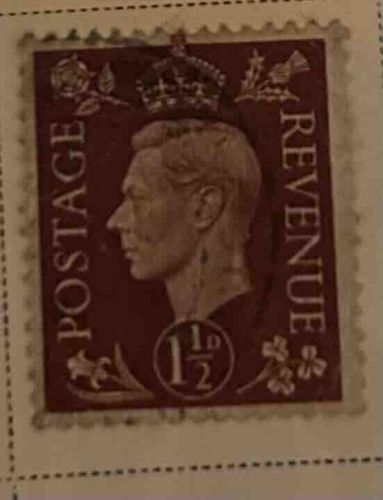
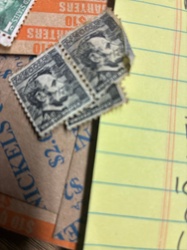
This item is a King George VI 1 1/2d postage and revenue stamp, likely issued by Great Britain. The stamp features a portrait of King George VI in profile, facing left, with a crown centrally positioned above his head. The color of the stamp appears to be a warm, deep maroon or reddish-brown, printed on what would typically be white or off-white paper. The stamp's design includes decorative elements in the corners: a rose in the upper left, a thistle (representing Scotland) in the upper right, a shamrock (representing Ireland) in the lower left, and a daffodil or leek (representing Wales) in the lower right, symbolizing the unity of the constituent countries of the United Kingdom. The words "POSTAGE" are printed vertically along the left side, and "REVENUE" vertically along the right side, both in a legible sans-serif font. The denomination "1 1/2 D" (one and a half pence) is clearly displayed within a circular frame at the bottom center of the stamp. The stamp exhibits perforations along all four edges, indicating it was part of a larger sheet. The visible condition suggests it is off paper, with some possible light toning or minor wear consistent with its age. There are no obvious tears, creases, or major damage, though the image quality makes precise assessment of condition issues challenging. The focus is slightly soft, obscuring very fine details, but the overall impression is of a relatively well-preserved example. This stamp would have been in circulation during King George VI's reign, which spanned from 1936 to 1952, placing its estimated age within that period. Its dual 'Postage and Revenue' designation implies it could be used for both postal services and as a fiscal stamp for certain legal documents. The craftsmanship appears standard for British postal issues of the era, with clear engraving and printing.
AI Appraisal Report
I have examined the provided image of the King George VI 1 1/2d Postage and Revenue Stamp. Based on the visual evidence, the stamp appears to be authentic and consistent with British postal issues from the King George VI era (1936-1952). The design, denomination, and 'Postage and Revenue' text are all typical for this specific stamp. I note the warm, deep maroon color and the clear display of the portrait and corner emblems (rose, thistle, shamrock, daffodil/leek).
Regarding its condition, the stamp seems to be off paper with perforations on all four sides. I observe no obvious tears, significant creases, or major damage, suggesting it is relatively well-preserved for its age. However, the image quality is somewhat soft, making a precise assessment of minor flaws like subtle toning, short perforations, or minor thinning challenging. Under a loupe, I would scrutinize the perforations, paper integrity, and check for any repairs or hidden defects.
From a market perspective, this specific stamp is a common issue. Millions were printed and used, making it readily available. As such, demand is generally low among serious collectors, though it holds appeal for entry-level or thematic collectors of British stamps or King George VI issues. Comparables abound, typically fetching very modest prices. Factors significantly impacting value would be pristine unmounted mint condition (which this is not), rare plate varieties, or specific cancellations, none of which are evident here.
It is crucial to state that while the visual inspection suggests authenticity, a definitive verification requires physical examination. I would need to inspect the paper type, watermark (if any), gum (if it were mint), printing method, and exact color shades. Provenance documentation, though unlikely for such a common stamp, would also confirm its history. Without physical inspection, I cannot confirm absolute authenticity or rule out subtle alterations or hidden imperfections that could affect value. However, based on the image, it presents as a genuine, but common, example.