AI identification & appraisal estimate

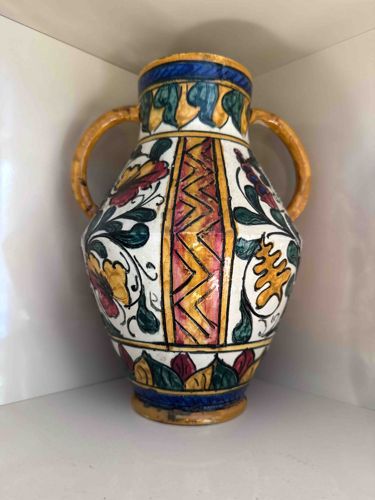
Vintage Spanish Majolica Two-Handled Vase

Submitted photo of Vintage Spanish Majolica Two-Handled Vase
Photo submitted by the user — not generated by AI

AI Estimated Value

Not an official valuation

$150 - $250

AI estimate as of February 9, 2026 · verify with a professional before acting

AI-Generated · Verify before acting

Everything on this page is generated by AI for informational purposes only. AI can make mistakes — the AI may misidentify items or misattribute them (artist, maker, brand, designer, origin, era). This is not an official valuation and should not be used for insurance, sale, tax, estate, legal, or lending purposes — or any decision requiring a certified appraisal. It is not an authoritative claim about any person, brand, or rights holder — do not share or rely on it as a factual statement about a third party. Always consult qualified professionals before making financial decisions.

Read the full disclaimer

AI Item Analysis

This is a hand-painted ceramic vase, likely of Spanish origin, featuring a dual-handled amphora shape. The piece is crafted from a base earthenware and finished with a tin-glaze (Majolica) technique. The color palette is vibrant and traditional, utilizing ochre yellow, deep cobalt blue, emerald green, and a reddish-pink mauve. The decorative scheme includes a central vertical panel with a geometric zigzag pattern, flanked by organic floral sprigs and scrolling foliage. The top and bottom of the globular body are bordered by stylized leaf or petal motifs and cobalt blue bands. The two handles are arched and finished in a solid ochre yellow glaze. Regarding condition, there is visible glaze loss and chipping along the top rim and bottom foot, which is common for this type of friable ceramic. Fine crazing is present throughout the glazed surface, indicating significant age, likely dating to the early to mid-20th century. The hand-painted brushwork shows a charming, folk-art quality with visible variation in thickness and pigment density, suggesting a workshop production rather than a mass-manufactured piece. No maker's mark is visible from this angle, but the style is strongly reminiscent of Talavera or Manises pottery traditions.
AI Appraisal Report

Based on my visual examination of the provided imagery, I have assessed this two-handled Majolica vase as a mid-20th-century piece, likely originating from the Spanish pottery centers of Talavera de la Reina or Puente del Arzobispo. The tin-glaze execution and palette—specifically the use of antimony yellow and copper green—are consistent with traditional Iberian folk-art aesthetics. The condition shows character-appropriate wear; the chipping at the rim and foot reveals the porous earthenware body, which is typical for 'loza' of this period. The fine crazing across the glaze indicates natural aging and thermal expansion over several decades. Currently, the market for mid-century Spanish Majolica remains stable but niche. While the decorative appeal is high due to the vibrant hand-painted scrolls and geometric central band, the value is tempered by the lack of a visible maker's mark and the presence of significant glaze losses. Similar examples at auction frequently realize prices in the $150 to $250 range. Higher valuations would require attribution to a specific master workshop like Ruiz de Luna. Limitations: This appraisal is based solely on digital photographs. A definitive valuation would require in-person inspection to verify the density of the ceramic, check for concealed structural repairs under UV light, and examine the underside for faint incised marks. Provenance documentation or a verified workshop stamp would be necessary to elevate this from a decorative folk-art piece to a collector-grade specimen.

Keep exploring

More antique and vintage ceramics appraisals

Get your items appraised

Instant AI-powered appraisal estimates from a photo

Browse More Appraisals