Senufo Kpelie Mask with Hornbill Superstructure
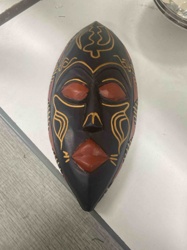
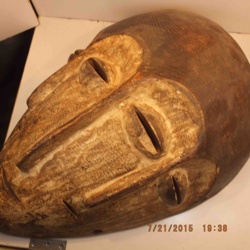
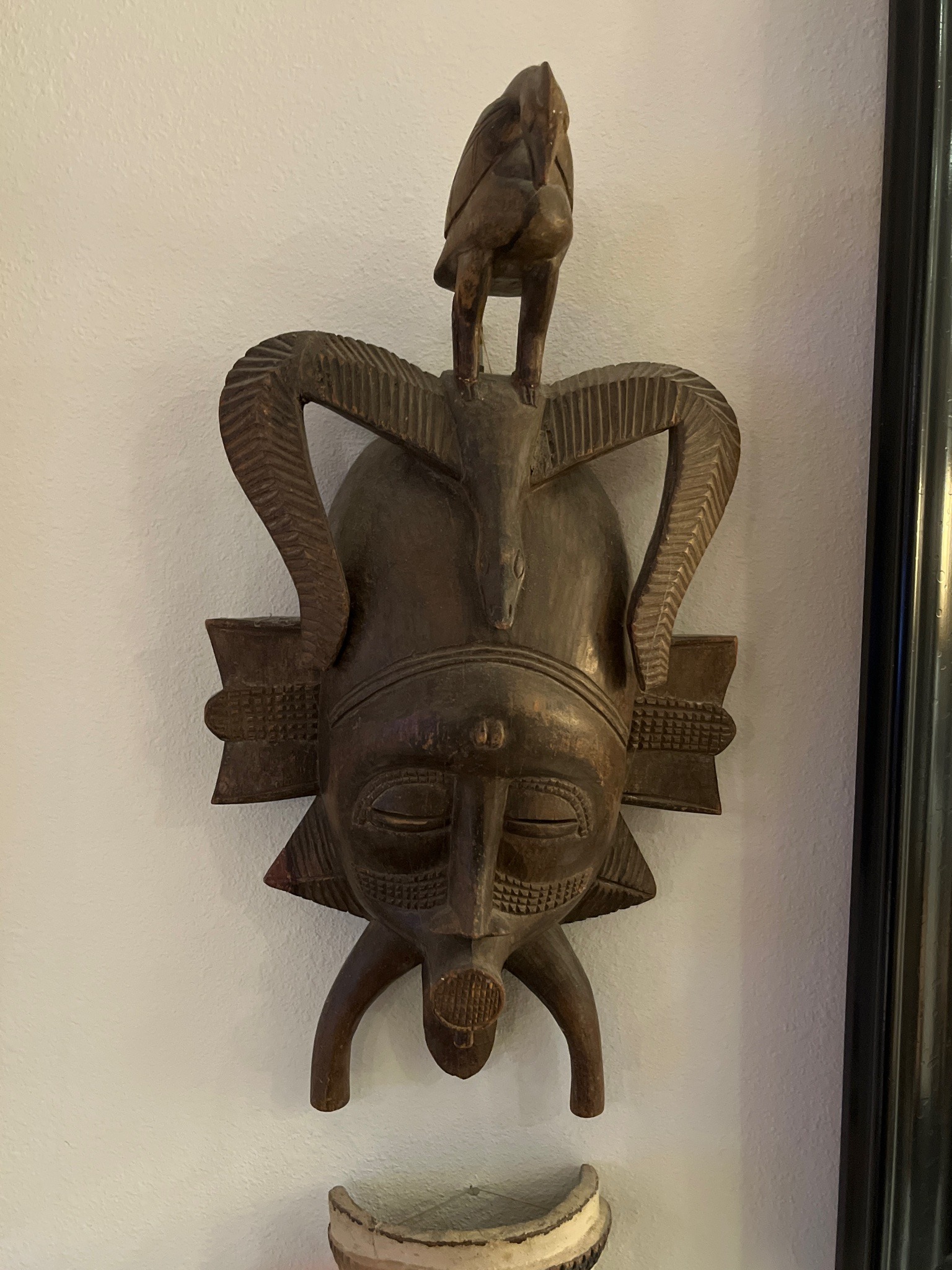
This is a hand-carved wooden kpelie mask, an anthropomorphic mask originating from the Senufo people of Ivory Coast, West Africa. The mask features a smooth, vaulted forehead and an elongated face, culminating in a protruded rectangular mouth with incised geometric patterns. It is characterized by its complex symmetry, including two downward-curving elements at the chin and stylized side projections commonly referred to as 'ears' or 'wings,' which feature cross-hatched incisions. A highly distinctive superstructure decorates the top, consisting of two large, horizontally ribbed horns flanking a central figure of a hornbill bird—a sacred symbol in Senufo cosmology representing fertility and growth. The mask is carved from a single piece of dark, dense wood with a deep brown, semi-lustrous patina, suggesting age and frequent handling or polishing. Visible wear includes minor characteristic scuffing on projecting edges, a slight drying of the wood grain, and small circular punctures near the hairline presumably for attachments. The craftsmanship is evident in the precise execution of the fine geometric scarification patterns around the almond-shaped, slit eyes and cheek areas. Based on the stylistic execution and surface condition, the piece likely dates to the mid-to-late 20th century and was likely produced as an ethnographic art piece for the collector market, though it maintains the traditional proportions used in Poro society ceremonies.
AI-Generated Appraisal Disclaimer
Estimated Value
$450 - $700
Basic Information
Category
African Tribal Art / Ethnographic Collectibles
Appraised On
April 29, 2026
Estimated Value
$450 - $700
Item Description
This is a hand-carved wooden kpelie mask, an anthropomorphic mask originating from the Senufo people of Ivory Coast, West Africa. The mask features a smooth, vaulted forehead and an elongated face, culminating in a protruded rectangular mouth with incised geometric patterns. It is characterized by its complex symmetry, including two downward-curving elements at the chin and stylized side projections commonly referred to as 'ears' or 'wings,' which feature cross-hatched incisions. A highly distinctive superstructure decorates the top, consisting of two large, horizontally ribbed horns flanking a central figure of a hornbill bird—a sacred symbol in Senufo cosmology representing fertility and growth. The mask is carved from a single piece of dark, dense wood with a deep brown, semi-lustrous patina, suggesting age and frequent handling or polishing. Visible wear includes minor characteristic scuffing on projecting edges, a slight drying of the wood grain, and small circular punctures near the hairline presumably for attachments. The craftsmanship is evident in the precise execution of the fine geometric scarification patterns around the almond-shaped, slit eyes and cheek areas. Based on the stylistic execution and surface condition, the piece likely dates to the mid-to-late 20th century and was likely produced as an ethnographic art piece for the collector market, though it maintains the traditional proportions used in Poro society ceremonies.

Get Your Items Appraised
Instant estimates of your treasures with AI-powered instant appraisals