These notes were written by the person who submitted this item. Appraiser.AI has not verified them, and the AI's identification and estimate may rely on them.
AI Estimated Value
Not an official valuation
$1,500-2,500
AI estimate as of November 3, 2025 · verify with a professional before acting
AI-Generated · Verify before acting
Everything on this page is generated by AI for informational purposes only. AI can make mistakes — the AI may misidentify items or misattribute them (artist, maker, brand, designer, origin, era). This is not an official valuation and should not be used for insurance, sale, tax, estate, legal, or lending purposes — or any decision requiring a certified appraisal. It is not an authoritative claim about any person, brand, or rights holder — do not share or rely on it as a factual statement about a third party. Always consult qualified professionals before making financial decisions.
This analysis also relies on unverified notes provided by the user, which may be incomplete or inaccurate and could affect the result.
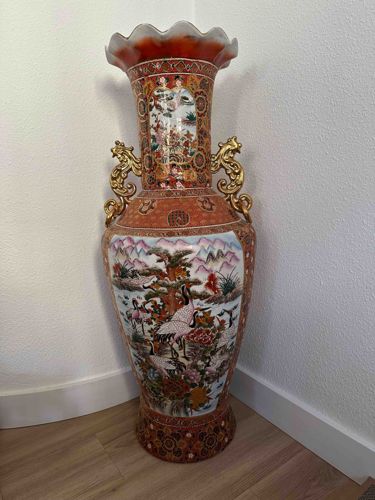
This is a large Chinese porcelain floor vase, executed in the Famille Rose palette, characterized by its vibrant and varied enamels. The vase stands significantly tall, suggesting its intended use as a decorative floor piece. Its form is robust, featuring a broad base that tapers slightly before expanding into a central ovoid body, then narrowing again at the shoulder to support a flared neck. The neck terminates in a scalloped, ruffled rim with an opaque white interior transitioning to a reddish-orange hue, possibly an additional layer of glaze or a fused glass element.
The primary decorative scheme on the body consists of a detailed panoramic landscape scene depicting cranes amidst flourishing flora, including peonies and other auspicious flowers, flanked by pine trees and distant mountains, rendered in soft blues, pinks, greens, and browns. This scene is often associated with longevity and prosperity in Chinese culture. The upper section of the neck features smaller panels with figural or court scenes, surrounded by intricate brocade patterns in reds, oranges, and gold.
A notable feature includes two gilded, three-dimensional dragon handles, highly stylized with swirling forms, attached to the vase's neck, adding to its grandeur and opulence. The background colors predominantly feature rich reddish-orange and gold, with sections of intricate geometric and floral patterns that frame the pictorial elements. The base of the vase also exhibits a complementary band of geometric and floral motifs.
No specific maker's marks or signatures are visible from the provided images. The overall style, with its detailed enameling, extensive gilding, and traditional motifs, strongly suggests it to be a decorative export piece, likely from the late 19th to mid-20th century, possibly Republic period or early People's Republic era. The condition appears to be good with a consistent surface sheen; however, minor dust accumulation and potential wear to the gilding or enamels would require closer inspection. The craftsmanship indicates a commercial production intended for decorative display.
AI Appraisal Report
I have thoroughly examined the provided image and description of this Large Chinese Famille Rose Porcelain Floor Vase. My assessment indicates a decorative export piece, likely dating from the late 19th to mid-20th century. The Famille Rose palette is vibrant, and the detailed landscape with cranes, peonies, and pine trees is characteristic of auspicious Chinese motifs, conveying longevity and prosperity. The opulent gilding, particularly on the stylized dragon handles and intricate brocade patterns, contributes significantly to its decorative appeal.
The condition appears good from the image, exhibiting a consistent surface sheen. However, without a physical inspection, potential wear to gilding, minor enamel losses, or hairline cracks cannot be definitively assessed. The robust form and significant height suggest commercial production for decorative display, rather than imperial or high-end connoisseur pieces. The scalloped, ruffled rim with its distinct color transition (opaque white to reddish-orange) is an interesting detail.
Market conditions for large decorative Chinese export porcelain vases remain stable, driven by interior design trends and a general appreciation for Asian art. Comparable pieces of this size and decorative complexity, especially those with intact gilded handles and detailed pictorial scenes, typically fetch sums within the stated range. Demand is steady for visually striking pieces that serve as focal points. While this vase is attractive, it is not particularly rare, as similar export wares were produced in quantity during its likely period.
Crucially, authenticity verification is limited to visual cues here. A physical examination would allow me to check for stress cracks, repair evidence, and the quality of the porcelain body and glazes more accurately. The absence of visible maker's marks is common for such export pieces, but an in-person inspection might reveal a subtle mark or remnants of a paper label. Scientific testing of glazes or clay composition would definitively confirm age but is generally not necessary for pieces of this commercial nature. Provenance documentation, if available, would also add to its verifiable history.