These notes were written by the person who submitted this item. Appraiser.AI has not verified them, and the AI's identification and estimate may rely on them.
AI Estimated Value
Not an official valuation
$2,500 - $4,000
AI estimate as of July 31, 2025 · verify with a professional before acting
AI-Generated · Verify before acting
Everything on this page is generated by AI for informational purposes only. AI can make mistakes — the AI may misidentify items or misattribute them (artist, maker, brand, designer, origin, era). This is not an official valuation and should not be used for insurance, sale, tax, estate, legal, or lending purposes — or any decision requiring a certified appraisal. It is not an authoritative claim about any person, brand, or rights holder — do not share or rely on it as a factual statement about a third party. Always consult qualified professionals before making financial decisions.
This analysis also relies on unverified notes provided by the user, which may be incomplete or inaccurate and could affect the result.
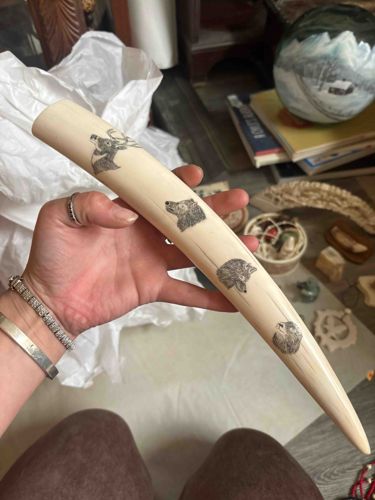
This item is an elongated, curved tusk-like object, likely carved from walrus or mammoth ivory, given the context of 'hand carved ivory Alaskan native art.' It exhibits a creamy, off-white coloration characteristic of aged ivory, with a smooth, polished surface. The overall form tapers from a wider, cylindrical base to a pointed tip, suggesting it could be a a 'cribbage board' carved from a tusk or simply a decorative carving. It measures approximately the length of a forearm. The unique aspect of this piece is the intricate scrimshaw work displayed along its length. Four distinct animal heads are present, facing generally 'outwards' as if observing. From top to bottom (as held in the image), the first animal appears to be a caribou or moose, distinguished by its prominent antlers. Below it is a bear head, followed by what looks like a wolf or coyote head, and finally, another wolf-like animal or perhaps a fox. These depictions are rendered in black or dark grey pigment, etched into the ivory's surface with fine detail to suggest fur, eyes, and facial features. The craftsmanship appears to be of high quality, demonstrating skill in both the carving of the ivory and the scrimshaw technique. No clear visible damage such as cracks or major chips are apparent, though typical signs of age-related patina or minor surface wear might be present on closer inspection. There are no obvious maker's marks or signatures visible in the provided image. The style aligns with traditional Alaskan Native art, particularly those traditions that incorporate scrimshaw on marine mammal ivory, dating it likely to the 20th century, possibly mid to late. The piece appears to be in good overall condition, indicative of being well-preserved.
AI Appraisal Report
Upon visual examination of this scrimshawed tusk, it presents as a fine example of 20th-century Alaskan Native artistry. The material appears consistent with aged walrus ivory, exhibiting a desirable off-white patina. The craftsmanship is skilled, with four detailed scrimshaw depictions of Alaskan wildlife—likely a caribou, bear, and two canids (wolves/foxes)—rendered with precision. The carving is fluid and the overall condition appears excellent, with no visible cracks or significant damage from the provided image.
The market for authentic, high-quality Alaskan Native art remains strong. Comparable scrimshawed walrus tusks from the mid-to-late 20th century, particularly those of this size and with multiple, well-executed animal figures, command significant prices. The rarity of such pieces, combined with the high level of skill, drives demand among collectors.
However, this appraisal is limited by the inability to conduct a physical inspection. Final authentication requires in-person examination to confirm the material is not bone or a synthetic substitute. Verifying the type of ivory (walrus vs. mammoth) and its age through expert analysis or testing would be crucial. Furthermore, any provenance documentation, such as a bill of sale, artist's signature (which is not visible), or CITES/MMPA paperwork, would be necessary to legally confirm its marketability and significantly solidify its value. Without this, the piece's authenticity and legal status for sale remain unconfirmed.