Seated Faux Ivory Budai (Laughing Buddha) Figurine
Religious and Cultural Decorative Arts

Seated Faux Ivory Budai (Laughing Buddha) Figurine

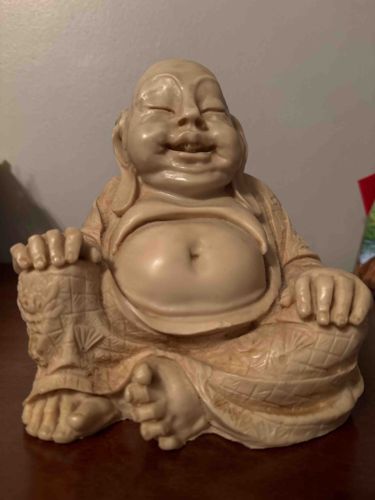
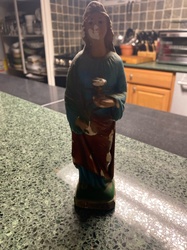
This is a mid-to-late 20th-century decorative figurine of Budai, commonly known as the Laughing Buddha, depicted in a traditional seated pose. The figure is cast from a cream-colored resin or composite material designed to imitate the appearance of aged ivory, featuring a smooth, polished finish on the high points and darker pigments settled into the recessed areas to simulate a natural patina. Physically, the figure displays the characteristic portly physique, elongated earlobes, and a joyous facial expression with squinted eyes and an open mouth. He is draped in traditional robes embellished with incised geometric and cross-hatch patterns that suggest embroidery or woven textile details. His right hand rests upon a cloth sack (treasure bag), while his left hand rests on his knee. Measuring approximately 4 to 6 inches in height, the construction appears to be a solid mold-cast process common for mass-market decorative arts produced in Mexico. Notably, there are visible mold lines along the base and side, and some minor surface abrasions and dust accumulation in the crevices indicate it has been used as a home decor object. The overall craftsmanship is consistent with high-volume souvenir or export ware rather than artisanal hand-carving. The coloring is a uniform off-white with artificial tea-staining to provide depth. No specific artist signatures are visible, but the provided context confirms a Mexican origin, likely dating from the 1970s to the 1990s.
Estimated Value

$25.00 - $45.00

Basic Information

Category

Religious and Cultural Decorative Arts

Appraised On

March 9, 2026

Estimated Value

$25.00 - $45.00

Additional Details Provided By Owner

User Provided Information

Made in Mexico

Item Description

This is a mid-to-late 20th-century decorative figurine of Budai, commonly known as the Laughing Buddha, depicted in a traditional seated pose. The figure is cast from a cream-colored resin or composite material designed to imitate the appearance of aged ivory, featuring a smooth, polished finish on the high points and darker pigments settled into the recessed areas to simulate a natural patina. Physically, the figure displays the characteristic portly physique, elongated earlobes, and a joyous facial expression with squinted eyes and an open mouth. He is draped in traditional robes embellished with incised geometric and cross-hatch patterns that suggest embroidery or woven textile details. His right hand rests upon a cloth sack (treasure bag), while his left hand rests on his knee. Measuring approximately 4 to 6 inches in height, the construction appears to be a solid mold-cast process common for mass-market decorative arts produced in Mexico. Notably, there are visible mold lines along the base and side, and some minor surface abrasions and dust accumulation in the crevices indicate it has been used as a home decor object. The overall craftsmanship is consistent with high-volume souvenir or export ware rather than artisanal hand-carving. The coloring is a uniform off-white with artificial tea-staining to provide depth. No specific artist signatures are visible, but the provided context confirms a Mexican origin, likely dating from the 1970s to the 1990s.
Get Your Items Appraised

Instant estimates of your treasures with AI-powered instant appraisals

Browse More Appraisals